
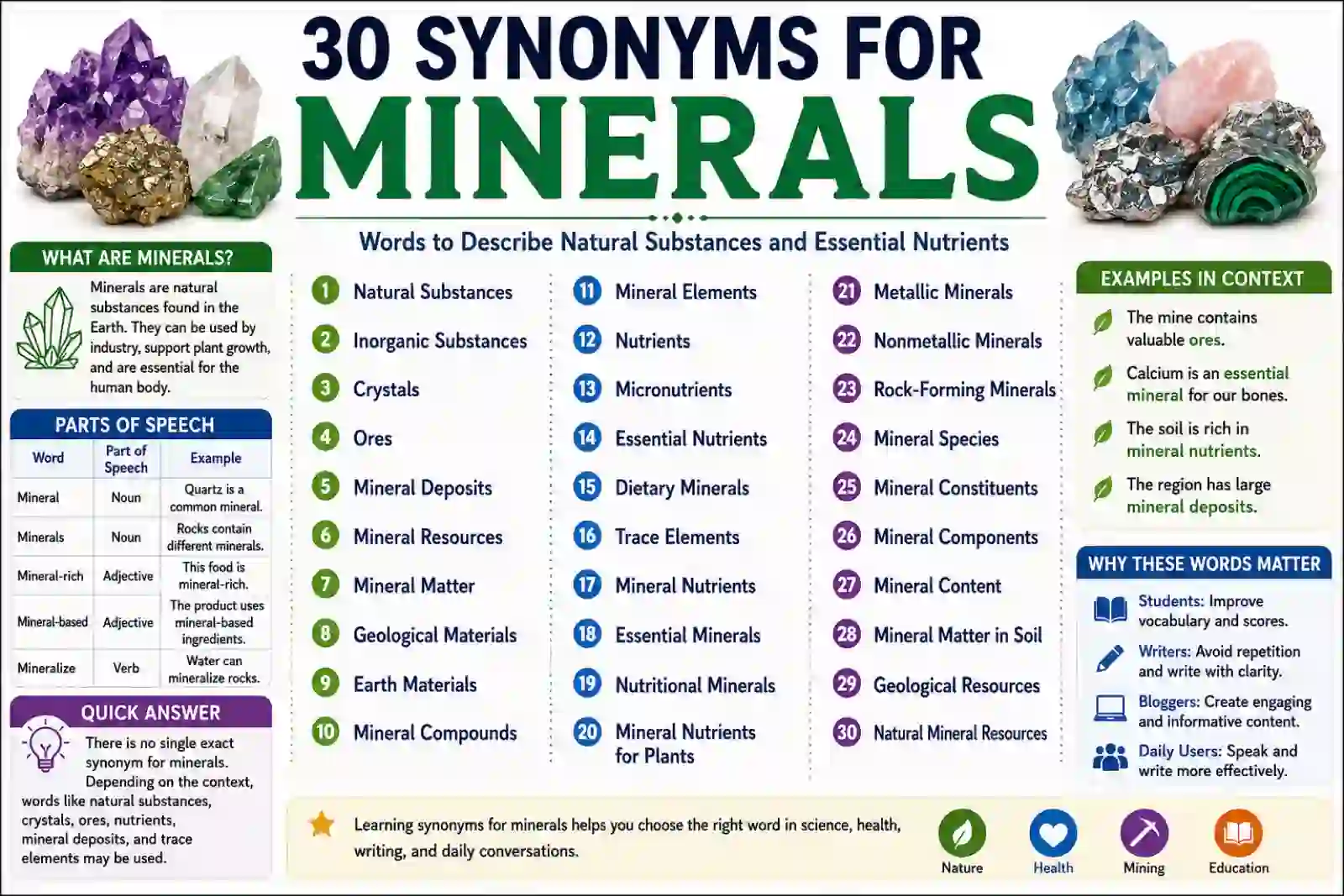
Have you ever wondered what gives your body strength or what makes rocks so different? The answer often starts with minerals.
For example, calcium is a mineral that helps keep your bones strong. Gold is also a mineral found in nature and used for many purposes.
The phrase synonyms for minerals can mean different things depending on the context.
In science minerals are naturally occurring substances found in the Earth.In nutrition, minerals are nutrients that the body needs in small amounts. In mining, words like ores, deposits, and mineral resources may describe related materials or sources.
Learning these words helps students understand science topics. Bloggers and content writers can avoid repeating the same word. Daily English users can also describe natural materials and nutrients more clearly
.Quick Answer: What Are the Synonyms for Minerals?
There is no single exact synonym for minerals because the word has different meanings. In geology, related terms include natural substances, inorganic substances, crystals, ores, mineral deposits, and mineral resources. In nutrition, useful related terms include nutrients,
Parts of Speech
| Word | Part of Speech | Simple Meaning | Example |
| Mineral | Noun | A natural substance found in the Earth | Quartz is a common mineral. |
| Minerals | Noun | More than one mineral | Rocks contain different minerals. |
| Mineral-based | Adjective | Made from or related to minerals | The product uses mineral-based materials. |
| Mineral-rich | Adjective | Containing many minerals | This food is mineral-rich. |
| Mineralized | Adjective | Containing or changed by minerals | The water passed through mineralized rock. |
30 Synonyms and Related Words for Minerals
1. Natural Substances
Meaning
Natural substances are materials that occur in nature.
Examples
- Minerals are natural substances found in rocks.
- The Earth contains many natural substances.
2. Inorganic Substances
Meaning
Inorganic substances are substances that are generally not made by living things.
Examples
- Many minerals are inorganic substances.
- The science class studied inorganic substances.
3. Crystals
Meaning
Crystals are solid materials whose atoms form a regular pattern.
Examples
- Some minerals form beautiful crystals.
- The cave contained large crystals.
4. Ores
Meaning
Ores are rocks or materials that contain useful minerals that can be taken out.
Examples
- The mine contains valuable ores.
- Workers found iron ores underground.
5. Mineral Deposits
Meaning
Mineral deposits are natural areas where minerals are found in useful amounts.
Examples
- The region has large mineral deposits.
- Scientists searched for new mineral deposits.
6. Mineral Resources
Meaning
Mineral resources are useful mineral materials found in the Earth.
Examples
- The country has many mineral resources.
- Mining companies study mineral resources before digging.
7. Mineral Matter
Meaning
Mineral matter is material made up of minerals.
Examples
- The soil contains mineral matter.
- Plants can get minerals from mineral matter in the soil.
8. Geological Materials
Meaning
Geological materials are natural materials that come from the Earth.
Examples
- Rocks are important geological materials.
- The study focused on geological materials.
9. Earth Materials
Meaning
Earth materials are natural materials found in or on the Earth.
Examples
- Minerals are common Earth materials.
- Students learned about different Earth materials.
10. Mineral Compounds
Meaning
Mineral compounds are chemical substances that contain mineral elements.
Examples
- Some mineral compounds occur naturally in rocks.
- The laboratory tested several mineral compounds.
11. Mineral Elements
Meaning
Mineral elements are chemical elements that occur in minerals or are needed by living things.
Examples
- Calcium is an important mineral element.
- Plants need several mineral elements to grow.
12. Nutrients
Meaning
Nutrients are substances that living things need to grow and stay healthy.
Examples
- Minerals are important nutrients.
- A healthy diet provides many nutrients.
13. Micronutrients
Meaning
Micronutrients are nutrients needed by the body in small amounts.
Examples
- Iron is an important micronutrient.
- Plants need several micronutrients.
14. Essential Nutrients
Meaning
Essential nutrients are nutrients that the body needs but cannot make enough of itself.
Examples
- Minerals are essential nutrients for the human body.
- We need several essential nutrients every day.
15. Dietary Minerals
Meaning
Dietary minerals are minerals that people get from food and drinks.
Examples
- Milk provides several dietary minerals.
- A balanced diet can supply important dietary minerals.
16. Trace Elements
Meaning
Trace elements are substances that the body needs in very small amounts.
Examples
- Zinc is an important trace element.
- The body needs some trace elements for normal function.
17. Mineral Nutrients
Meaning
Mineral nutrients are minerals that help living things grow and function properly.
Examples
- Plants need mineral nutrients from the soil.
- Calcium is an important mineral nutrient.
18. Essential Minerals
Meaning
Essential minerals are minerals that the body needs for normal health.
Examples
- Iron and calcium are essential minerals.
- A good diet provides many essential minerals.
19. Nutritional Minerals
Meaning
Nutritional minerals are minerals that support the body’s normal functions.
Examples
- Vegetables can provide useful nutritional minerals.
- The label lists several nutritional minerals.
20. Mineral Nutrients for Plants
Meaning
Mineral nutrients for plants are minerals that plants need to grow.
Examples
- Roots absorb mineral nutrients from the soil.
- Farmers check the soil for mineral nutrients.
21. Metallic Minerals
Meaning
Metallic minerals contain useful metals.
Examples
- Iron ore comes from metallic minerals.
- The mine produces several metallic minerals.
22. Nonmetallic Minerals
Meaning
Nonmetallic minerals are minerals that do not provide metals as their main useful product.
Examples
- Salt is a common nonmetallic mineral.
- The region has many nonmetallic minerals.
23. Rock-Forming Minerals
Meaning
Rock-forming minerals are minerals that make up most rocks.
Examples
- Quartz is a common rock-forming mineral.
- Students studied major rock-forming minerals.
24. Mineral Species
Meaning
A mineral species is a specific type of mineral with a defined chemical and physical structure.
Examples
- Scientists identified the mineral species in the sample.
- The museum displays many mineral species.
25. Mineral Constituents
Meaning
Mineral constituents are minerals that form part of a rock or material.
Examples
- The rock has several mineral constituents.
- Scientists examined the mineral constituents of the sample.
26. Mineral Components
Meaning
Mineral components are mineral parts found in a material.
Examples
- The soil contains several mineral components.
- The test measured the mineral components of the sample.
27. Mineral Content
Meaning
Mineral content means the amount or type of minerals present in something.
Examples
- The label shows the mineral content of the drink.
- Scientists measured the mineral content of the soil.
28. Mineral Matter in Soil
Meaning
Mineral matter in soil is the non-living mineral material found in the ground.
Examples
- Mineral matter helps shape soil quality.
- The farmer tested the mineral matter in the soil.
29. Geological Resources
Meaning
Geological resources are useful natural materials found in the Earth.
Examples
- Minerals are valuable geological resources.
- The country is rich in geological resources.
30. Natural Mineral Resources
Meaning
Natural mineral resources are useful minerals that occur naturally in the Earth.
Examples
- The region has many natural mineral resources.
- Mining can provide access to natural mineral resources.
How to Choose the Right Synonym for Minerals
The word minerals changes meaning based on context.
In Geology
Use terms such as:
- Crystals
- Ores
- Mineral deposits
- Mineral resources
- Rock-forming minerals
- Mineral species
These words are useful when discussing rocks, Earth science, mining, and geology.
In Nutrition
Use terms such as:
- Nutrients
- Micronutrients
- Essential nutrients
- Dietary minerals
- Trace elements
- Mineral nutrients
These terms are useful when talking about food, health, plants, and nutrition.
In Mining
Use terms such as:
- Ores
- Mineral deposits
- Mineral resources
- Metallic minerals
- Nonmetallic minerals
These words describe mineral materials and their sources in the Earth.
Remember that these are not all exact synonyms. Some describe a type, source, function, or category of minerals. Choosing the correct term makes your writing more accurate.
Minerals in Different Contexts
Minerals in Science
Example:
“Quartz and feldspar are common minerals found in many rocks.”
Words such as crystals, mineral species, and rock-forming minerals may fit this context.
Minerals in Nutrition
Example:
“Calcium and iron are important dietary minerals.”
Words such as nutrients, micronutrients, and essential minerals are useful here.
Minerals in Mining
Example:
“The area is known for its mineral deposits.”
Words such as ores, mineral resources, and geological resources may fit this context.
Minerals in Agriculture
Example:
“Plants need mineral nutrients from the soil.”
Terms such as mineral nutrients and mineral elements are useful when discussing plant growth.
Common Mistakes When Using Minerals Synonyms
Mistake 1: Calling Every Mineral an Ore
❌ All minerals are ores.
✅ Some ores contain valuable minerals.
An ore is a material that contains useful substances that can be extracted.
Mistake 2: Using Nutrient in Every Situation
❌ The rock contains many nutrients.
✅ The rock contains many minerals.
Nutrients usually refers to substances needed by living things.
Mistake 3: Confusing Minerals With Rocks
❌ Granite is a single mineral.
✅ Granite is a rock made of several minerals.
A rock can contain one or more minerals.
Mistake 4: Treating Micronutrients and Minerals as Identical
❌ Every mineral is a micronutrient.
✅ Some minerals act as micronutrients in the body.
The terms are related but do not have exactly the same meaning.
Mistake 5: Using Crystals as a Universal Synonym
❌ All minerals are called crystals in every context.
✅ Some minerals form crystal structures.
Crystals describe a structure or form, not a complete replacement for the word minerals.
Why Learn Synonyms for Minerals?
Learning synonyms for minerals and related vocabulary helps you choose precise words. Students can use these terms in science projects, essays, and exams. Bloggers and content writers can explain geology, nutrition, food, mining, and nature without repeating the same word.
These words also improve everyday communication. When you know the difference between minerals, nutrients, ores, crystals, and mineral resources, you can explain ideas more clearly.
Good vocabulary is not about using difficult words. It is about choosing the word that fits the meaning.
Frequently Asked Questions
1. What is another word for minerals?
There is no single exact synonym for minerals. Depending on the context, related terms include natural substances, inorganic substances, crystals, ores, mineral resources, nutrients, and micronutrients.
2. Are nutrients a synonym for minerals?
Not exactly. Minerals can be nutrients when they are needed by living things. However, the word nutrients includes other substances too, such as vitamins, proteins, fats, and carbohydrates.
3. Is ore another word for mineral?
Not exactly. An ore is a natural material that contains valuable substances that can be extracted. It may contain one or more useful minerals.
4. What are minerals called in nutrition?
In nutrition, minerals are often called dietary minerals or mineral nutrients. They are essential substances that the body needs for normal functions.
5. What is the difference between minerals and rocks?
A mineral is a naturally occurring substance with a specific chemical and physical structure. A rock is a natural solid material that may contain one or several minerals.
6. What are the main types of minerals?
Minerals can be grouped in different ways. In basic geology, they may be discussed as metallic and nonmetallic minerals. In nutrition, minerals are often grouped as major minerals and trace minerals.
7. Why are minerals important?
Minerals are important in many ways. They form rocks and Earth’s materials, provide useful resources for industry, and support important functions in plants, animals, and humans.
Conclusion
Learning synonyms for minerals helps you understand and explain science, nutrition, geology, and everyday topics more clearly. Words like crystals, ores, nutrients, micronutrients, mineral deposits, and mineral resources each have a special use. Practice these words in emails, essays, schoolwork, and daily conversations. Always check the context before choosing an alternative. When you use the right word, your writing becomes clearer, stronger, and easier to under

Habib Ullah is the founder of LanguagePilots, where he creates easy-to-understand English learning content to help students and professionals build confidence in communication.