
Have you ever heard that a person received an award after they died? This is called being honored posthumously.
For example, a famous writer may publish an important book during life but receive a major award after death. We can say, “The writer was honored posthumously.”
So, what does posthumously mean? What other words or phrases can you use instead?
This guide explains synonyms for posthumously in simple English. You will learn 30 useful alternatives with short meanings and real-life examples.
Quick Answer: Synonyms for Posthumously
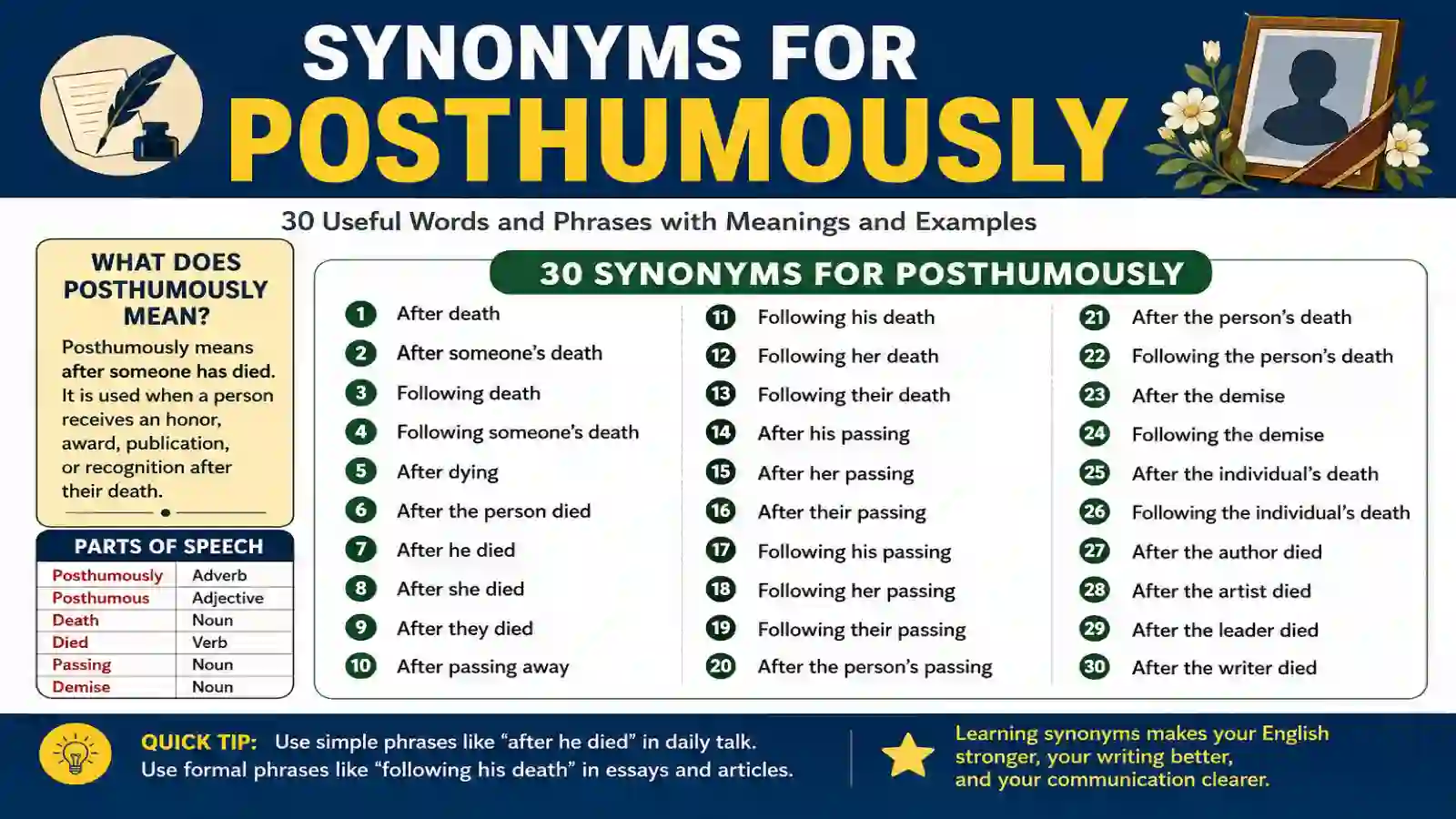
Posthumously means after a person has died.
Some useful synonyms and related phrases include:
- After death
- After someone’s death
- Following death
- Following someone’s death
- After dying
- After the person died
- After he died
- After she died
- After they died
- After passing away
- Following his death
- Following her death
- Following their death
- After his passing
- After her passing
- After their passing
- Following his passing
- Following her passing
- Following their passing
- After the person’s passing
- After the person’s death
- Following the person’s death
- After the demise
- Following the demise
- After the individual’s death
- Following the individual’s death
- After the author died
- After the artist died
- After the leader died
- After the writer died
Parts of Speech
| Word | Part of Speech | Simple Meaning |
| Posthumously | Adverb | After someone dies |
| Posthumous | Adjective | Happening after someone’s death |
| Death | Noun | The end of a person’s life |
| Died | Verb | Stopped living |
| Passing | Noun | A gentle way to say death |
| Passing away | Phrasal verb | A gentle way to say someone died |
| Demise | Noun | A formal word for death |
30 Synonyms for Posthumously
1. After Death
Meaning: Something happens after a person has died.
Examples:
- The artist received the award after death.
- His final book became famous after death.
2. After Someone’s Death
Meaning: Something happens after a particular person dies.
Examples:
- The family found the letter after someone’s death.
- The museum opened after the founder’s death.
3. Following Death
Meaning: Something happens after death.
Examples:
- The book became popular following death.
- The award was given following his death.
4. Following Someone’s Death
Meaning: Something happens after a person’s death.
Examples:
- The company changed following the owner’s death.
- Many people visited the town following the leader’s death.
5. After Dying
Meaning: Something happens after a person dies.
Examples:
- The singer became famous after dying.
- His painting sold for more money after dying.
6. After the Person Died
Meaning: Something happened after that person died.
Examples:
- The truth became known after the person died.
- The diary was found after the person died.
7. After He Died
Meaning: Something happened after a male person died.
Examples:
- His poems became popular after he died.
- The award was presented after he died.
8. After She Died
Meaning: Something happened after a female person died.
Examples:
- Her paintings became famous after she died.
- The charity grew after she died.
9. After They Died
Meaning: Something happened after a person or group of people died.
Examples:
- Their work was discovered after they died.
- The family published their letters after they died.
10. After Passing Away
Meaning: Something happens after a person dies.
Examples:
- His novel was published after passing away.
- Her music became famous after passing away.
11. Following His Death
Meaning: Something happened after a man died.
Examples:
- The school was named after him following his death.
- His paintings gained value following his death.
12. Following Her Death
Meaning: Something happened after a woman died.
Examples:
- Her foundation continued following her death.
- The book was released following her death.
13. Following Their Death
Meaning: Something happens after a person dies.
Examples:
- The family sold the house following their death.
- The collection was displayed following their death.
14. After His Passing
Meaning: Something happened after a man died.
Examples:
- His students created a scholarship after his passing.
- The town held a ceremony after his passing.
15. After Her Passing
Meaning: Something happened after a woman died.
Examples:
- Her children donated her books after her passing.
- The hospital honored her after her passing.
16. After Their Passing
Meaning: Something happened after a person or people died.
Examples:
- The family continued their work after their passing.
- Their photographs were shown after their passing.
17. Following His Passing
Meaning: Something happened after a man died.
Examples:
- His work received new attention following his passing.
- The family created a fund following his passing.
18. Following Her Passing
Meaning: Something happened after a woman died.
Examples:
- Her students published her notes following her passing.
- The city held a memorial following her passing.
19. Following Their Passing
Meaning: Something happened after a person or people died.
Examples:
- Their books were donated following their passing.
- The organization continued following their passing.
20. After the Person’s Passing
Meaning: Something happens after a person dies.
Examples:
- The family discovered the painting after the person’s passing.
- The award was announced after the person’s passing.
21. After the Person’s Death
Meaning: Something happens after a person’s death.
Examples:
- The letter was published after the person’s death.
- His work gained attention after the person’s death.
22. Following the Person’s Death
Meaning: Something happens after a person has died.
Examples:
- The project continued following the person’s death.
- The family released the records following the person’s death.
23. After the Demise
Meaning: Something happens after a person’s death.
Examples:
- The company changed after the demise of its founder.
- His work became valuable after the demise of the artist.
24. Following the Demise
Meaning: Something happens after a person’s death.
Examples:
- The family met following the demise of their grandfather.
- The organization changed following the demise of its leader.
25. After the Individual’s Death
Meaning: Something happens after a particular person dies.
Examples:
- The records were opened after the individual’s death.
- The award was created after the individual’s death.
26. Following the Individual’s Death
Meaning: Something happens after a particular person has died.
Examples:
- The collection grew following the individual’s death.
- The museum displayed his work following the individual’s death.
27. After the Author Died
Meaning: Something happens after a writer has died.
Examples:
- The novel became popular after the author died.
- Several poems were published after the author died.
28. After the Artist Died
Meaning: Something happens after an artist has died.
Examples:
- The painting became valuable after the artist died.
- The gallery displayed her work after the artist died.
29. After the Leader Died
Meaning: Something happens after a leader has died.
Examples:
- The group changed after the leader died.
- A memorial was built after the leader died.
30. After the Writer Died
Meaning: Something happens after a writer has died.
Examples:
- The writer’s diary was published after the writer died.
- His stories became famous after the writer died.
- Read more
Why Learn Synonyms for Posthumously?
Learning different ways to express posthumously can make your English more flexible.
Students can use these phrases in essays, assignments, and history projects.
Bloggers can avoid using the same word again and again. This makes articles smoother and easier to read.
Content writers can choose the right phrase for different audiences. A formal phrase such as “following his death” may work well in an article.
Daily English users can use simple phrases such as “after he died” or “after her passing” when speaking with others.
Remember that posthumously is usually more formal. Simple phrases are often better for everyday conversation.
Posthumously vs. Posthumous
These two words are closely related, but they have different jobs.
Posthumously is an adverb. It describes an action that happened after someone’s death.
Example:
- The author was honored posthumously.
Posthumous is an adjective. It describes something that appears or happens after someone’s death.
Example:
- The author received a posthumous award.
A simple way to remember this is:
Posthumously = how something happened.
Posthumous = describes something.
How to Use Posthumously in a Sentence
The word posthumously is common in formal writing.
Here are some examples:
- The scientist received the award posthumously.
- His final book was published posthumously.
- The artist was honored posthumously for his work.
- She received a medal posthumously.
In casual English, you can often replace it with a simpler phrase.
For example:
Formal:
The writer was honored posthumously.
Simple:
The writer was honored after he died.
Both sentences communicate the same basic idea.
When Should You Use These Synonyms?
The best synonym depends on your audience.
For formal writing,
- Following his death
- Following her death
- After his passing
- After her passing
- Following the person’s death
For simple English,
- After he died
- After she died
- After they died
- After the person died
- After death
respectful writing, phrases such as “after his passing” and “after her passing” can sound gentler.
academic writing, “following his death” or “after the individual’s death” may sound more suitable.
Frequently Asked Questions
1. What does posthumously mean?
Posthumously means that something happens after a person has died.
2. What is the simplest synonym for posthumously?
“After death” is one of the simplest ways to express the basic meaning.
3. Is posthumously a noun?
No. Posthumously is an adverb.
4. What is the adjective form of posthumously?
The adjective form is posthumous.
For example: “He received a posthumous award.”
5. Is “after he died” a synonym for posthumously?
Yes. “After he died” can express the same basic idea in simple English.
6. Is “after passing away” a respectful phrase?
Yes. “After passing away” is a gentle and respectful way to refer to what happens after someone’s death.
7. What is the difference between posthumous and posthumous?
Posthumous is an adjective, while posthumously is an adverb. Posthumous describes something, while posthumously describes an action.
Conclusion
Learning synonyms posthumously can make your English more flexible and natural. You can use simple phrases like “after he died” in daily conversations and formal phrases like “following his death” in essays or articles. Knowing these alternatives also helps bloggers and content writers avoid repetition. Practice these words in your emails, essays, blog posts, and daily conversations. The more you use them, the more confident and clear your English will become.

Habib Ullah is the founder of LanguagePilots, where he creates easy-to-understand English learning content to help students and professionals build confidence in communication.