
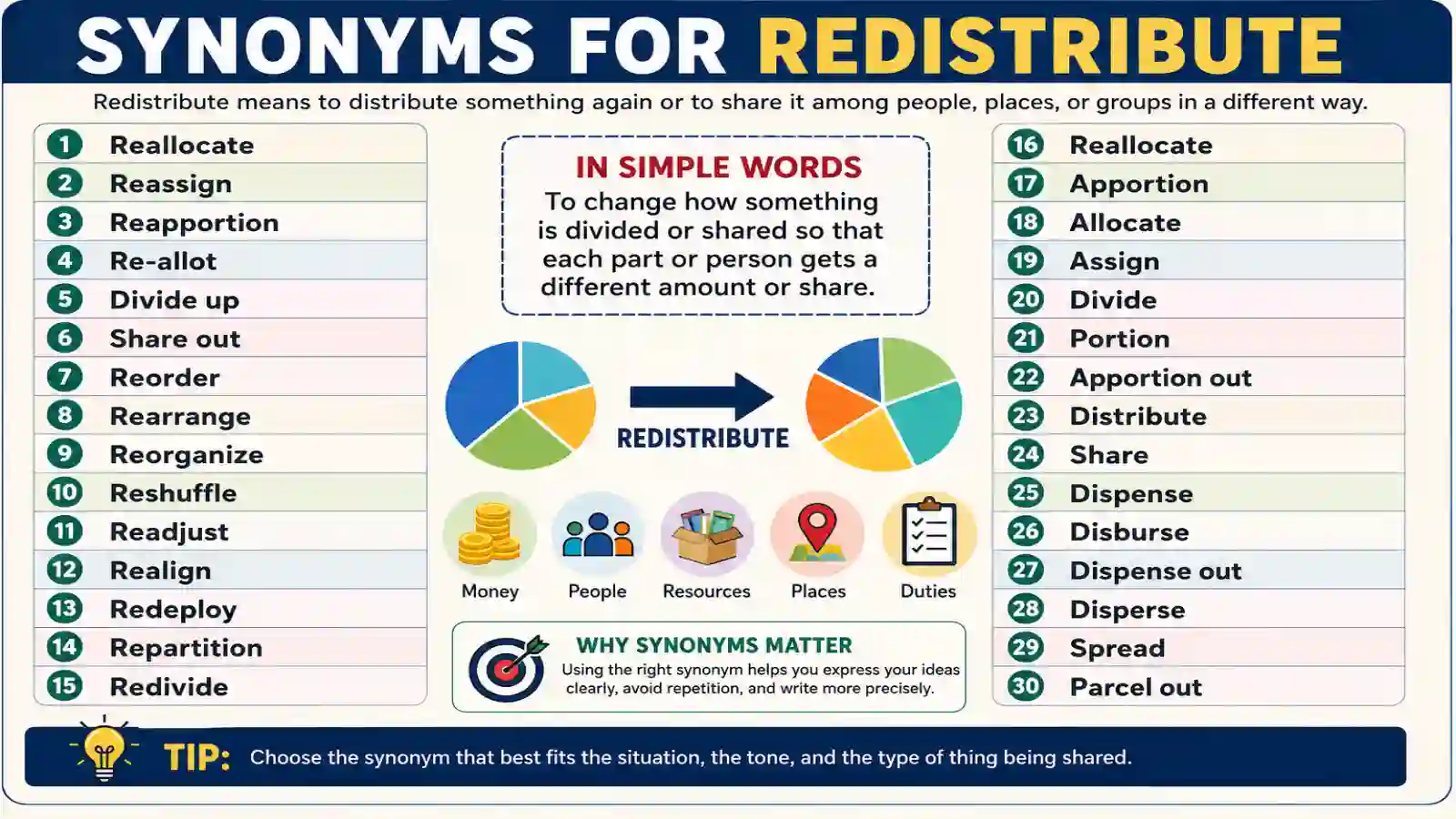
Redistribute means to change how something is shared among people, places, or groups.
A company has five departments. One has too much money, while another lacks funds. The manager may reallocate funds to ensure a more equitable distribution. Similarly, a government may change how land, income, or public funds are shared.
Redistribute means to share something in a new way. This often aims to create a fairer, more balanced arrangement. It commonly applies to resources, power, duties, and information.
Mastering these synonyms helps English learners avoid repeating words. It also lets writers pick exact terms for business, government, or economic contexts. This article explains the word’s meaning and history. It also lists synonyms, antonyms, and common uses.
Meaning of Redistribute
Definition
Redistribute (verb): to share something again or spread it among people, places, or groups in a new way.
Examples
- The government chose to move money from rich areas to those in greater need.
- The teacher redistributed the students among the groups to create a better balance.
Connotative Meaning
- It can show fairness, balance, smarter use of resources, or fix an unfair arrangement.
- Negative tone: In political or economic discussions, it can suggest taking resources from one group and giving them to another, which some people may view negatively.
- Neutral tone: It can simply describe changing the way something is divided or spread.
(Connotation means the feeling or idea that a word can suggest beyond its basic dictionary meaning.)
Etymology
Redistribute is formed from re- + distribute. The prefix re- means “again,” “back,” or “anew.” Distribute comes from Middle English, which in turn comes from the Latin word “distributus.” This means “to divide” or “deal out in portions.” Latin distribuere contains dis-, meaning “apart,” and tribuere, meaning “to assign, grant, or allot.”
So, the literal idea behind redistribute is “to distribute again” or “to allot anew.” The word first appeared in English in the early 17th century. Its modern political-economy meaning came much later. (Merriam-Webster)
Short History
- Old English (450–1100): People discussed sharing or giving things, but the word redistribute hadn’t been created yet.
- Middle English (1100–1500): Latin and French greatly shaped English vocabulary. Distribute entered English during this period, ultimately from Latin distribuere, meaning to divide or allot. (Merriam-Webster)
- Modern English (1500–Present): The word “redistribute” came into English in the early 1600s. It meant to distribute again or to apportion afresh. Its political and economic use for changing the distribution of wealth became established in the 19th century. (Etymology Online)
Pronunciation (US & UK – IPA)
- US: /ˌriː.dɪˈstrɪb.juːt/
- UK: /ˌriː.dɪˈstrɪb.juːt/ (Cambridge Dictionary)
Syllables
re-dis-trib-ute
Affixation Pattern of Redistribute
- Root: tribute / tribu-, ultimately related to Latin tribuere, meaning “to assign, grant, or allot.” (Merriam-Webster)
- Prefix: re-, meaning “again,” “back,” or “anew.”
- Suffix: -e, part of the verb’s historical spelling rather than a productive English suffix with a separate grammatical function.
Word Formation
- redistribute (verb) — the base verb meaning to distribute again or differently.
- redistribution (noun) — the act or process of redistributing something.
- redistributive (adjective) — relating to the redistribution of something, especially wealth or resources.
These related forms are established English words. (Merriam-Webster)
A List of 30 Synonyms for Redistribute
1. Reallocate (verb)
US /ˌriːˈæləkeɪt/ | UK /ˌriːˈæləkeɪt/
Meaning: To assign money, resources, or responsibilities to different uses or recipients.
Examples: The manager decided to reallocate the unused budget to the training program. The agency will reallocate staff to offices with heavier workloads.
2. Reassign (verb)
US /ˌriːəˈsaɪn/ | UK /ˌriːəˈsaɪn/
Meaning: To give a person, task, responsibility, or resource to a different place or role.
Examples: The supervisor reassigned the project to another team. Several employees were reassigned to departments that needed more support.
3. Reapportion (verb)
US /ˌriːəˈpɔːrʃən/ | UK /ˌriːəˈpɔːʃən/
Meaning: To divide or assign something again according to a new proportion.
Examples: The committee voted to reapportion the funding among the districts. Officials must reapportion seats after the population changes.
4. Re-allot (verb)
US /ˌriːəˈlɑːt/ | UK /ˌriːəˈlɒt/
Meaning: To give or assign something again in different amounts or to different recipients.
Examples: The school decided to re-allot classroom space after enrollment increased. The committee will re-allot the remaining funds next month.
5. Divide up (verb)
US /dɪˈvaɪd ʌp/ | UK /dɪˈvaɪd ʌp/
Meaning: To split something into portions and distribute them among different people or groups.
Examples: The organizer divided up the supplies among the volunteers. We need to divide up the remaining budget more carefully.
6. Share out (verb)
US /ˈʃer aʊt/ | UK /ˈʃeə aʊt/
Meaning: To divide something among several people or groups.
Examples: The team shared out the available equipment equally. The charity shared out the donated food among several shelters.
7. Reorder (verb)
US /ˌriːˈɔːrdər/ | UK /ˌriːˈɔːdə/
To arrange things in a different sequence.
Examples: The editor reordered the sections to improve the report. The warehouse reordered its stock across different locations.
8. Rearrange (verb)
US /ˌriːəˈreɪndʒ/ | UK /ˌriːəˈreɪndʒ/
The term means to change the arrangement or distribution of things.
Examples: The manager rearranged the available staff across the branches. We rearranged the chairs so that every student had enough space.
9. Reorganize (verb)
US /ˌriːˈɔːrɡənaɪz/ | UK /ˌriːˈɔːɡənaɪz/
Meaning: To arrange people, resources, or activities differently to improve a system.
Examples: The company reorganized its departments after the merger. The nonprofit reorganized its resources to serve more communities.
10. Reshuffle (verb)
US /ˌriːˈʃʌfəl/ | UK /ˌriːˈʃʌfəl/
Meaning: To reorder or rearrange existing roles, personnel, or elements within a group.
Examples: The director reshuffled the teams before the new project began. The government reshuffled several responsibilities between ministries.
READ More: 30 Synonyms of Reorganize with Examples & Explanation
11. Readjust (verb)
US /ˌriːəˈdʒʌst/ | UK /ˌriːəˈdʒʌst/
Meaning: To make a new adjustment to improve balance or suitability.
Examples: The company readjusted its budget after sales declined. The engineer readjusted the weight distribution of the machine.
12. Realign (verb)
US /ˌriːəˈlaɪn/ | UK /ˌriːəˈlaɪn/
Meaning: To alter the position, layout, or priorities of something to suit a new plan.
Examples: The organization realigned its resources with its new goals. The school realigned its teaching staff after enrollment changed.
13. Redeploy (verb)
US /ˌriːdɪˈplɔɪ/ | UK /ˌriːdɪˈplɔɪ/
Definition: To adjust how something is organised or arranged to suit a new situation or goal.
Examples: The company redeployed workers to its busiest branches. The government redeployed emergency resources to the affected region.
14. Répartition (verb)
US /ˌriːpɑːrˈtɪʃən/ | UK /ˌriːpɑːˈtɪʃən/
Meaning: To divide something into new parts or sections.
Examples: The administrator repartitioned the storage space on the system. The planners repartitioned the land into smaller sections.
15. Redivide (verb)
US /ˌriːdɪˈvaɪd/ | UK /ˌriːdɪˈvaɪd/
Meaning: To divide something again in a different way.
Examples: The farmers decided to redivide the land among the families. The committee will redivide the project budget into new categories.
16. Reallocate (verb)
US /ˌriːˈæləkeɪt/ | UK /ˌriːˈæləkeɪt/
Meaning: To distribute resources again by assigning them to different purposes or recipients.
Examples: The university reallocated money from unused projects to scholarships. The director reallocated staff according to current demand.
17. Apportion (verb)
US /əˈpɔːrʃən/ | UK /əˈpɔːʃən/
Meaning: To divide something among people or purposes according to a particular share.
Examples: The committee apportioned the funds among five departments. The partners apportioned the expenses according to their ownership shares.
18. Allocate (verb)
US /ˈæləkeɪt/ | UK /ˈæləkeɪt/
Meaning: To assign resources, money, time, or space for particular purposes.
Examples: The school allocated extra money to science programs. The manager allocated more workers to the busiest store.
19. Assign (verb)
US /əˈsaɪn/ | UK /əˈsaɪn/
Meaning: To give a task, responsibility, place, or resource to someone or something.
Examples: The supervisor assigned the new duties to another team. The coordinator assigned more volunteers to the crowded shelter.
20. Divide (verb)
US /dɪˈvaɪd/ | UK /dɪˈvaɪd/
Meaning: To separate something into parts or portions.
Examples: The committee divided the grant among several local groups. We divided the available space among the participating teams.
READ More: 30 Synonyms of Allocate with Examples & Explanation
21. Portion (verb)
US /ˈpɔːrʃən/ | UK /ˈpɔːʃən/
Meaning: To divide something into particular amounts or shares.
Examples: The chef portioned the food for each group. The charity portioned the supplies according to the number of families.
22. Apportion out (verb)
US /əˈpɔːrʃən aʊt/ | UK /əˈpɔːʃən aʊt/
Definition: To divide and distribute among recipients.
Examples: The board apportioned out the remaining funds among the departments. The organizers apportioned out the equipment before the event.
23. Distribute (verb)
US /dɪˈstrɪbjuːt/ | UK /dɪˈstrɪbjuːt/
Meaning: To allocate resources among various individuals or locations.
Examples: The volunteers distributed food to every household. The company distributes products through several regional offices.
24. Share (verb)
US /ʃer/ | UK /ʃeə/
To give or deliver something to people.
Examples: The organization shared its resources with smaller community groups. The team shared the available equipment among all participants.
25. Dispense (verb)
US /dɪˈspens/ | UK /dɪˈspens/
Meaning: To give out something in measured or controlled amounts.
Examples: The pharmacy dispensed the medicine according to each prescription. The machine dispenses equal amounts of material into each container.
26. Disburse (verb)
US /dɪsˈbɜːrs/ | UK /dɪsˈbɜːs/
Meaning: To pay or distribute money, especially from an organized fund.
Examples: The office disbursed the scholarship payments before the semester began. The agency will disburse emergency funds to approved applicants.
27. Dispense out (verb)
US /dɪˈspens aʊt/ | UK /dɪˈspens aʊt/
Meaning: To give something out to different people or places.
Examples: The volunteers dispensed out supplies to families waiting outside. The machine dispensed out equal portions for each package.
28. Disperse (verb)
US /dɪˈspɜːrs/ | UK /dɪˈspɜːs/
Meaning: To spread something or send it in different directions or places.
Examples: The system disperses water across several fields. The organization dispersed its emergency supplies among remote communities.
29. Spread (verb)
US /spred/ | UK /spred/
Meaning: To extend or distribute something over a wider area.
Examples: The farmer spread the fertilizer evenly across the field. The network spread its resources across several smaller centers.
30. Parcel out (verb)
US /ˈpɑːrsəl aʊt/ | UK /ˈpɑːsəl aʊt/
Meaning: To divide something into smaller portions and give them to different people or groups.
Examples: The administrator parceled out the remaining funds among the departments. The land was parceled out into smaller plots for local families.
READ More: 30 synonyms for chivalrous with Examples & Explanation
Prototype Meaning
Native speakers often think of something that’s been split or given out when they hear “redistribute.” Now, it is being shared differently. The typical examples involve money, land, duties, power, staff, supplies, or other resources. The word often suggests a deliberate change rather than a random movement. It doesn’t always mean taking something unfairly. However, political and economic uses can make that connection.
Prototype Categorization
- Direct reallocation of resources: reallocate, reassign, reapportion, re-allot, allocate, redeploy
- Dividing into new portions: divide up, apportion, portion, redivide, repartition, parcel out
- Changing an existing arrangement: rearrange, reorder, reorganize, reshuffle, readjust, realign
- General distribution: distribute, share, dispense, disburse, spread
- Spreading across places: disperse, spread, deploy, redeploy
Grouping synonyms by their meaning helps writers pick the right word for the action. For example, “reallocate” is great for resources. “Reapportion” highlights proportions. On the other hand, “reshuffle” is about changing positions or assignments.
Antonyms of Redistribute
- Withhold (verb): to refuse to give something that is due or expected.
- Retain (verb): to continue to have or hold something.
- Concentrate (verb): to focus or cluster something in a specific area or group.
- Keep (verb): to continue to have or hold something in one’s possession.
- Misallocate (verb): to assign resources to an unsuitable or incorrect use.
Short Questions and Answers
- What does redistribute mean? Redistribute means to share something again or change how it’s divided among people, groups, or places.
- When should redistribute be used? Use “redistribute” when you change how something that has been given out is shared, where it goes, who gets it, or how it’s used.
- Is redistribution positive or negative? It is neutral by itself. It can sound positive when it suggests greater fairness or balance, but it may carry positive or negative associations in political and economic discussions.
- How is redistribution different from similar words? Reallocate focuses on changing the use or assignment of resources, reapportion emphasizes changing proportions, and reassign often concerns people, duties, or responsibilities. Redistribute is broader and emphasizes changing how something is shared.
Conclusion
Learning “redistribute” and its synonyms helps English learners discuss resources, money, duties, land, information, and other shared items more clearly. Words such as reallocate, reassign, reapportion, rearrange, divide, distribute, and disperse each carry slightly different meanings and uses. Knowing these differences helps you avoid repetition. It also lets you communicate more naturally in academic, professional, and everyday English. Build confidence by practicing one new synonym every day.

Habib Ullah is the founder of LanguagePilots, where he creates easy-to-understand English learning content to help students and professionals build confidence in communication.