Have you ever used the word weekly several times in the same paragraph? It is a useful word, but repeating it again and again can make your writing sound less natural. Learning different synonyms for weekly can help you express the same idea in fresh ways. For example, you can say, “We have a weekly meeting, You can also say, “We have a meeting every week.” Both sentences tell us that the meeting happens each week.
Weekly means someone does or shares something once a week. It can work as an adjective or an adverb
. For example we can say “a weekly report” or “We send the report weekly.” Cambridge Dictionary
This guide explains 30 useful alternatives. Students can use them in essays. Bloggers and content writers can avoid repetition. English learners can also use them in emails, conversations, and everyday writing.
What Does “Weekly” Mean?
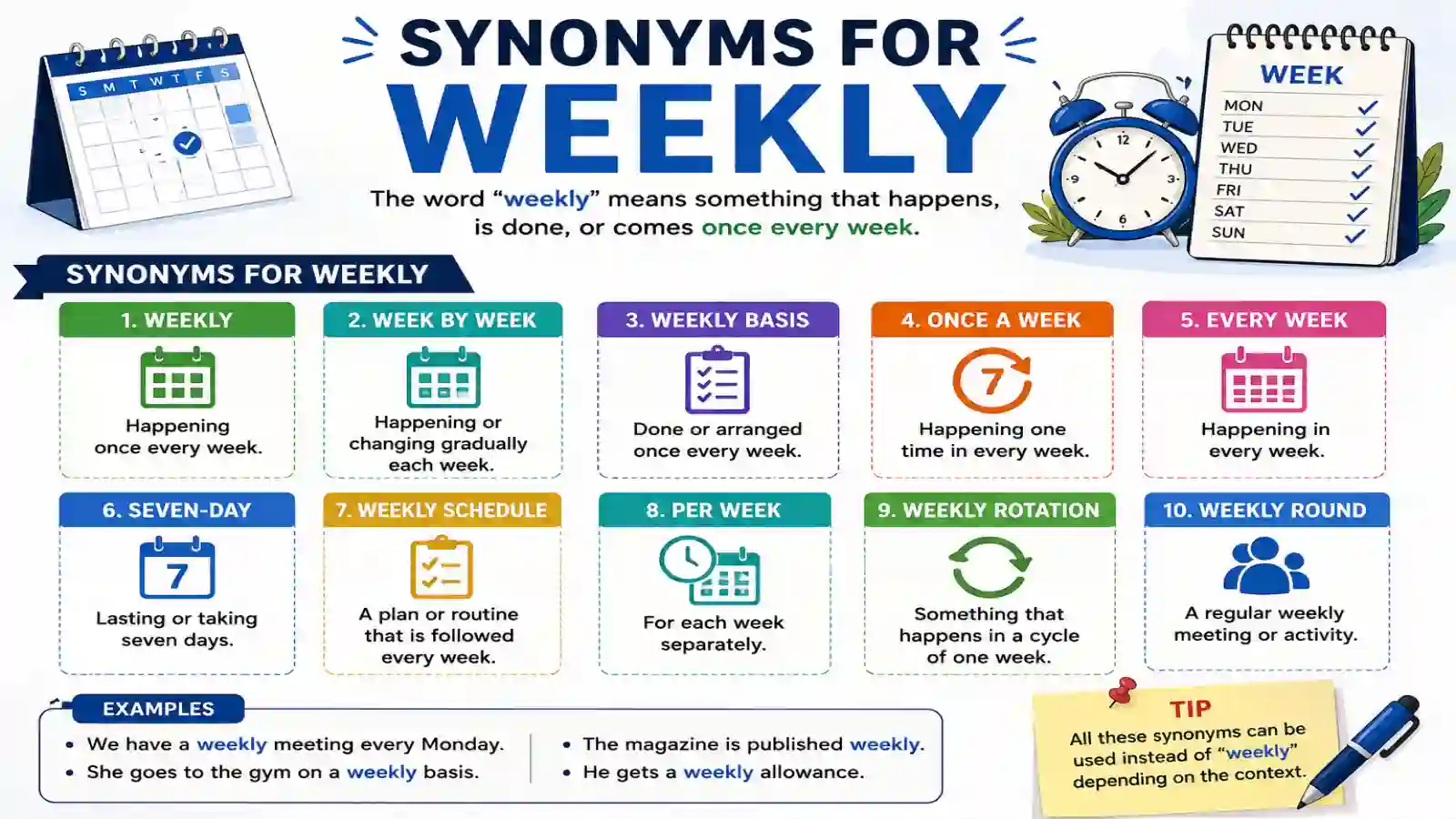
Weekly means that something happens, is done, or appears once every week.
You can use it as an adjective.
We have a weekly English class.
Here, the weekly describes the English class.
You can also use it as an adverb.
We practice English weekly.
Here, the weekly explains how often we practice.
1. Every Week
Meaning: Something happens during each week.
Examples:
- I call my grandmother every week.
- We have an English test every week.
Best for: Everyday speaking and simple writing.
“Every week” is one of the most natural alternatives to weekly.
2. Each Week
Meaning:Something happens during every week.
Examples:
- She learns five new words each week.
- We clean the classroom each week.
Best for: General English and writing.
“Each week” is very close in meaning to “every week.”
3. Once a Week
Meaning: Something happens one time during each week.
Examples:
- I visit the library once a week.
- Our teacher gives us a quiz once a week.
Best for: When you want to clearly show that something happens one time per week.
4. Once Every Week
Meaning: Something happens one time in every week.
Examples:
- The club meets once every week.
- I check my study plan once every week.
Best for: Clear explanations of frequency.
5. Every Seven Days
Meaning: Something happens after each period of seven days.
Examples:
- The system checks the information every seven days.
- I change my study goals every seven days.
Best for: Situations where the seven-day period matters.
6. Each Seven-Day Period
Meaning: Something happens during every period of seven days.
Examples:
- The report records activity during each seven-day period.
- The team reviews the results during each seven-day period.
Best for: Formal or technical writing.
This is more formal than simply saying each week.
7. Per Week
Meaning: Something happens or is measured for each week.
Examples:
- I read two books per week.
- The class has three lessons per week.
Best for: Numbers, rates, amounts, and schedules.
For instance, “three times per week” shows the reader how often it happens.
8. Week by Week
Meaning: Something happens or changes as each week passes.
Examples:
- Her English improves week by week.
- The project becomes easier week by week.
Best for: Showing progress or change.
9. Week After Week
Meaning: Something continues for many weeks.
Examples:
- He practiced the piano week after week.
- The team worked hard week after week.
Best for: Showing that something continues repeatedly.
Oxford describes week after week as something continuing for many weeks. (Oxford Learner’s Dictionaries)
10. Week In, Week Out
Meaning: Something happens every week without stopping.
Examples:
- She teaches the class week in, week out.
- He goes jogging week in, week out.
Best for: Repeated actions, especially in informal English.
Oxford lists week in, week out as meaning something that happens every week. (Oxford Learner’s Dictionaries)
11. From Week to Week
Meaning: Something changes or is considered as one week follows another.
Examples:
- Her schedule changes from week to week.
- The number of visitors varies from week to week.
Best for: Describing changes between different weeks.
It is not a perfect synonym for weekly, so use it when the idea of variation matters.
12. On a Weekly Basis
Meaning: Something happens every week.
Examples:
- We review the results on a weekly basis.
- The manager receives reports on a weekly basis.
Best for: Formal, business, and professional writing.
Cambridge examples also use “on a weekly basis” for actions that happen each week. (Cambridge Dictionary)
13. At Weekly Intervals
Meaning: Something happens once after each week.
Examples:
- The students take the test at weekly intervals.
- The team checks the equipment at weekly intervals.
Best for: Formal or technical writing.
For simple English, every week is usually clearer.
14. At Intervals of One Week
Meaning: Something happens after each one-week period.
Examples:
- The reports are submitted at intervals of one week.
- The samples are checked at intervals of one week.
Best for: Technical or formal contexts.
This phrase is more formal than most everyday alternatives.
15. One Time Each Week
Meaning: Something happens one time during every week.
Examples:
- I attend one class each week.
- We have one team meeting each week.
Best for: Clearly describing one weekly occurrence.
In everyday English, once a week is usually shorter and more natural.
16. Recurring Each Week
Meaning: Something happens again during every week.
Examples:
- The meeting is recurring each week.
- The event is recurring each week during the summer.
Best for: Events, schedules, and repeated activities.
A more natural sentence in many situations would be “The meeting happens every week.”
17. Repeated Each Week
Meaning: Something happens again every week.
Examples:
- We repeat the same exercise each week.
- We repeat the safety check each week.
Best for: Instructions, routines, and repeated tasks.
18. Scheduled Each Week
We plan something for every week.
Examples:
- The school schedules the lessons each week.
- A team meeting is scheduled each week.
Best for: Plans, calendars, classes, and appointments.
19. Held Each Week
Meaning: An event or meeting takes place every week.
Examples:
- The club meeting is held each week.
- The workshop is held each week at the library.
Best for: Meetings, classes, workshops, and events.
20. Published Each Week
Meaning: Something is made available every week.
Examples:
- A new article is published by the team each week.
- The magazine is published each week.
Best for: Articles, magazines, newspapers, newsletters, and other publications.
21. Issued Each Week
Something is officially given or released each week.
Examples:
- The company issues the report each week.
- New instructions are issued each week.
Best for: Reports, notices, statements, and official information.
22. Sent Each Week
Meaning: Something is delivered or sent every week.
Examples:
- The newsletter is sent each week.
- My teacher sends an update each week.
Best for: Emails, newsletters, messages, and updates.
23. Reported Each Week
Meaning: Information is given or recorded every week.
Examples:
- The results are reported each week.
- Sales numbers are reported each week.
Best for: Business, school, research, and news contexts.
24. Paid Each Week
Meaning: Money is given every week.
Examples:
- The workers are paid each week.
- I am paid each week for the work.
Best for: Talking about payment schedules.
Oxford gives examples of weekly payment and “per week” usage when discussing frequency. (Oxford Learner’s Dictionaries)
25. Updated Each Week
Meaning: Something receives new information every week.
Examples:
- The website is updated each week.
- The schedule is updated each week.
Best for: Websites, schedules, reports, apps, and online content.
26. Reviewed Each Week
Meaning: Something is checked or studied every week.
Examples:
- I review my vocabulary each week.
- The manager reviews the plan each week.
Best for: Study plans, work, projects, and progress checks.
27. Conducted Each Week
Meaning: An activity or process is carried out every week.
Examples:
- The survey is conducted each week.
- Safety checks are conducted each week.
Best for: Formal and professional writing.
For everyday English, done every week may be easier to understand.
28. Weekly Recurrence
Meaning: Something happens again at a weekly frequency.
Examples:
- The calendar shows a weekly recurrence.
- The app allows a weekly recurrence for the reminder.
Best for: Calendars, reminders, schedules, and software.
This is a noun phrase rather than a direct replacement for weekly in every sentence.
29. Seven-Day Cycle
Meaning: A repeating period that lasts seven days.
Examples:
- The project follows a seven-day cycle.
- The schedule runs on a seven-day cycle.
Best for: Plans, systems, schedules, and processes.
It’s about the weekly cycle. It shows the seven-day rhythm, not just that things happen every week.
30. Weeklong
Meaning: Something lasts for an entire week.
Examples:
- We joined a weeklong English course.
- She attended a weeklong training program.
Best for: Events, courses, trips, holidays, and activities lasting a full week.
Important: Weeklong is not a direct synonym for weekly. It means lasting one week, while weekly means happening every week. Oxford defines week-long as lasting for a week.
Best Synonyms for Weekly at a Glance
Alternative
Main Meaning
Best Use
Every week
Each week
Everyday English
Each week
Every week
General writing
Once a week
One time each week
Frequency
Per week
For each week
Numbers and rates
Every seven days
Each seven-day period
Clear timing
Week by week
As weeks pass
Progress or change
Week after week
Continuously for weeks
Repeated action
Week in, week out
Every week
Informal English
On a weekly basis
Every week
Formal writing
At weekly intervals
Once each week
Formal/technical writing
Published each week
Released every week
Content
Sent each week
Delivered every week
Emails/messages
Paid each week
Payment every week
Money
Updated each week
New information every week
Websites/data
Weeklong
Lasting one week
Events/courses
Weekly vs. Every Week
Weekly and every week often mean the same thing. However, they can play different roles in grammar.
Compare these sentences:
We have a weekly meeting.
We have a meeting every week.
In the first sentence, weekly is an adjective describing the meeting.
In the second sentence, every week is a time expression showing when the meeting happens.
Weekly vs. Once a Week
These expressions are often very close:
I have a weekly English class.
I have an English class once a week.
However, once a week puts special attention on the number of occurrences.
If something happens two times each week, you can say:
We meet twice a week.
You should not replace that meaning with once a week, because once means one time.
Weekly vs. Week by Week
These expressions are easy to confuse.
Weekly means something happens every week:
We have a weekly meeting.
Week by week describes something as time passes from one week to another:
Her English is improving week by week.
So, use weekly for frequency and week by week when you want to show gradual progress or change.
Weekly vs. Weeklong
This is another important difference.
Weekly means:
happening every week
Weeklong means:
lasting for one week
Compare:
We have a weekly English class.
The class happens every week.
We joined a weeklong English course.
The course lasts for one week.
Formal and Informal Alternatives for Weekly
Not every alternative sounds equally natural in every situation.
For Everyday English
Use:
- every week
- each week
- once a week
Example:
I practice English every week.
For Professional Writing
You can use:
- weekly
- on a weekly basis
- per week
- at weekly intervals
Example:
The team reviews the report on a weekly basis.
However, formal does not always mean better. If every week communicates your idea clearly, it is often the best choice.
Frequently Asked Questions
What is the most common synonym for weekly?
Every week is one of the most natural alternatives to weekly in everyday English. For example, “We have a weekly meeting” can become “We have a meeting every week.”
What is another way to say every week?
You can say each week, once a week, every seven days, or, in some contexts, on a weekly basis. The best choice depends on the sentence.
Is “every week” the same as “weekly”?
They often express the same basic idea, but their grammar is different. Weekly can be an adjective or adverb, while every week works as a time expression.
What is a formal way to say weekly?
On a weekly basis is a common formal alternative. At weekly intervals can also work in formal or technical contexts.
Can I say “once a week” instead of weekly?
Yes, when you mean something happens one time each week. For example, “I exercise weekly” can often become “I exercise once a week.”
Is “each week” correct English?
Yes. Each week is natural English and is often interchangeable with every week.
What is the difference between weekly and week by week?
Weekly describes frequency. Week by week focuses on how something develops or changes as the weeks pass.
Is “per week” a synonym for weekly?
It can be a useful alternative in sentences about rates, amounts, or frequency. For example, “three classes per week” means three classes each week.
What is the opposite of weekly?
There is no single perfect opposite in every context. You might use terms like daily, monthly, yearly, or irregular, depending on the meaning.
Conclusion
Learning synonyms for the week can make your English more flexible and natural. You do not need to replace it weekly every time, but knowing alternatives gives you more choices.
Use “every week” and “each week” in casual conversation, “once a week” for clear frequency. “on a weekly basis” when a formal tone is needed. Practice these expressions in your emails, essays, blog posts, and conversations. The more you use them, the easier they will become.

Habib Ullah is the founder of LanguagePilots, where he creates easy-to-understand English learning content to help students and professionals build confidence in communication.