
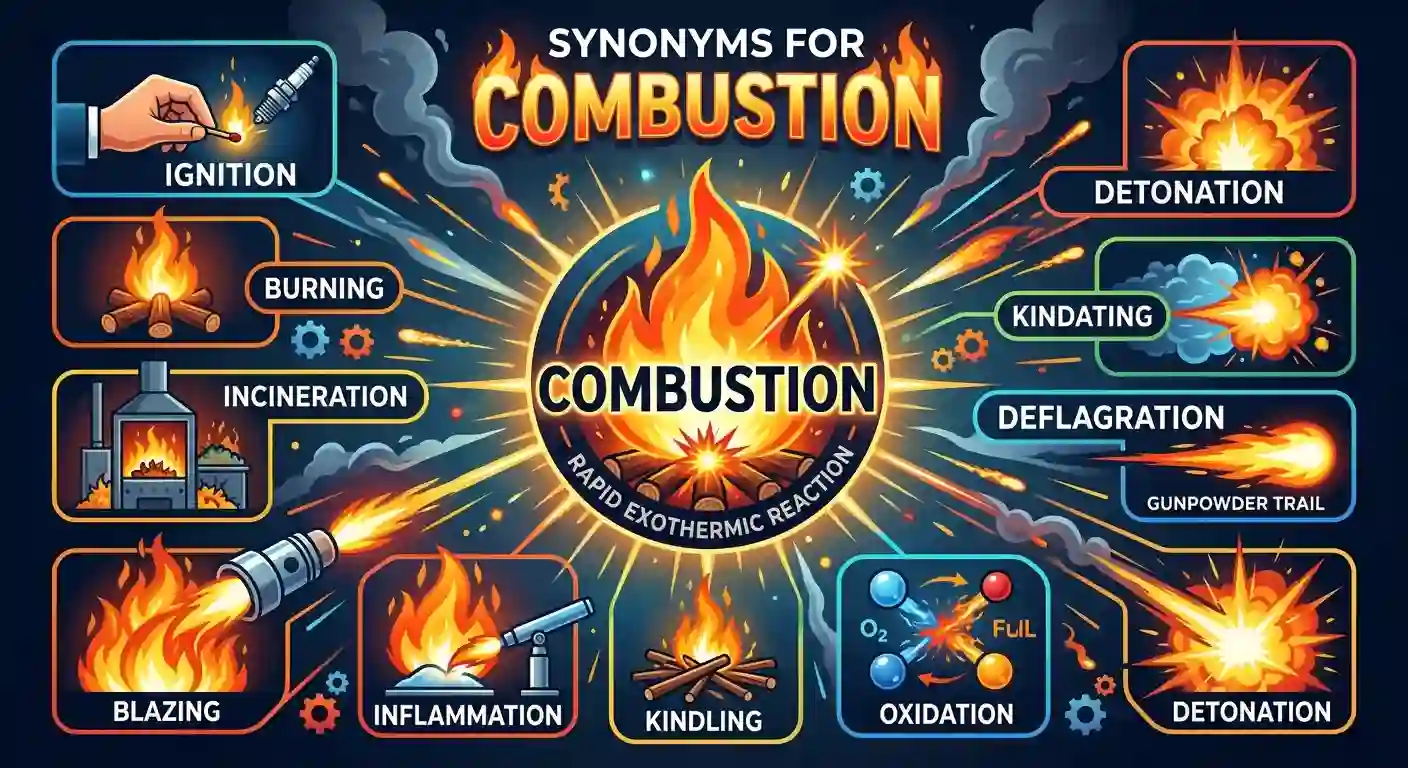
Combustion means the process of burning, especially a chemical reaction that produces heat and usually light.
Imagine a piece of wood placed in a fire. As it reacts with oxygen, it becomes hot, produces gases, and may give off a visible flame. A car engine also uses a controlled burning process to release energy from fuel.
The word combustion describes this burning process. It is common in science, engineering, environmental studies, cooking, and everyday descriptions of fire. Learning synonyms for combustion helps English learners avoid repetition and understand the difference between scientific and general words for burning. It also helps writers choose precise vocabulary for fires, chemical reactions, and destructive burning. This article explains the meaning, history, pronunciation, word formation, and 30 useful synonyms of combustion.
Meaning of Combustion
Definition
Combustion (noun): the process of burning, especially a chemical reaction in which a substance reacts with oxygen and produces heat and usually light.
Examples
- Complete combustion of the fuel produced enough heat to power the machine.
- Smoke and gases were released during the combustion of the dry leaves.
Connotative Meaning
- Positive tone: Combustion can suggest useful energy production, such as controlled burning in an engine or heating system.
- Negative tone: It can suggest destruction, fire, smoke, or harmful burning when used in environmental or emergency contexts.
- Neutral tone: It can simply describe the scientific process of burning without suggesting anything good or bad.
Etymology
Combustion entered English through Middle English and Anglo-French from Late Latin combustiō, meaning “burning” or “burning up.” The Latin noun comes from combūrere, meaning “to burn up” or “consume by fire.
The historical structure is complex. com- was used as an intensifying element, while the deeper Latin history connects the word with ūrere, meaning “to burn” or “singe.” The ending -ion forms a noun referring to an action or process.
Together, the historical sense was essentially the act or process of burning up.
Short History
- Old English (450–1100): English already had native words and expressions for burning, fire, flame, and related actions. The modern word combustion had not yet entered English.
- Middle English (1100–1500): French and Latin strongly influenced English vocabulary during this period. Combustion entered Middle English through Anglo-French and Late Latin, with the meaning of burning or burning up.
- Modern English (1500–Present): The word became established as a technical and general noun for burning. Today it is especially common in chemistry, engineering, environmental science, and descriptions of fuel use.
Pronunciation (US & UK – IPA)
- US: /kəmˈbʌstʃən/
- UK: /kəmˈbʌstʃən/
Syllables
- com-bus-tion
Affixation Pattern of Combustion
- Root: Historically connected with Latin ūrere, meaning “to burn” or “singe.”
- Prefix: com-, historically used as an intensifying element in this word.
- Suffix: -ion, a noun-forming suffix used for an action, process, or result.
The historical development is not a simple modern English prefix-plus-root construction. Sources note that the Latin form developed through combūrere and that the apparent bur- element reflects an old and imperfect separation of an earlier form.
Word Formation
- combustion (noun) – the process or act of burning.
- combust (verb) – to burn or cause to burn, although modern use is relatively uncommon.
- combustive (adjective/noun) – relating to or producing combustion.
- combustible (adjective) – capable of being burned.
- combustor (noun) – a device or chamber in which combustion occurs.
A List of 30 Synonyms for Combustion
1. Burning (noun)
US /ˈbɝːnɪŋ/ | UK /ˈbɜːnɪŋ/
Meaning: The process or act of being on fire or being consumed by fire.
Examples:
The burning of dry grass spread quickly across the field.
The laboratory studied the burning of different fuels.
2. Fire (noun)
US /faɪr/ | UK /faɪə/
Meaning: The visible process of burning that produces heat and often light.
Examples:
The fire consumed the old wooden shed.
Engineers designed the chamber to control the fire safely.
3. Flame (noun)
US /fleɪm/ | UK /fleɪm/
Meaning: The visible, hot part of a burning process.
Examples:
A blue flame appeared beneath the burner.
The flame became smaller when the gas supply was reduced.
4. Blaze (noun)
US /bleɪz/ | UK /bleɪz/
Meaning: A large or strongly burning fire.
Examples:
A sudden blaze damaged several buildings.
Firefighters worked through the night to control the blaze.
5. Flaming (noun)
US /ˈfleɪmɪŋ/ | UK /ˈfleɪmɪŋ/
Meaning: The state or process of burning with visible flames.
Examples:
The flaming material was moved away from the building.
The photograph showed flaming debris after the accident.
6. Incineration (noun)
US /ɪnˌsɪnəˈreɪʃən/ | UK /ɪnˌsɪnəˈreɪʃən/
Meaning: The process of destroying material by burning it, especially at high temperatures.
Examples:
The facility uses incineration to reduce certain types of waste.
Incineration transformed the waste into ash and gases.
7. Cremation (noun)
US /krɪˈmeɪʃən/ | UK /krɪˈmeɪʃən/
Meaning: The process of reducing a dead body to ashes by burning.
Examples:
The family chose cremation instead of burial.
Cremation takes place in a specially designed chamber.
8. Cineration (noun)
US /ˌsɪnəˈreɪʃən/ | UK /ˌsɪnəˈreɪʃən/
Meaning: The reduction of material to ashes by burning.
Examples:
The historical text used cineration to describe the burning process.
Cineration leaves a largely ash-based residue.
9. Incremation (noun)
US /ˌɪnkrəˈmeɪʃən/ | UK /ˌɪnkrəˈmeɪʃən/
Meaning: Burning or reducing something to ashes.
Examples:
The old document described incremation as a method of disposal.
The term incremation is mainly encountered in formal or historical contexts.
10. Oxidation (noun)
US /ˌɑːksɪˈdeɪʃən/ | UK /ˌɒksɪˈdeɪʃən/
Meaning: A chemical process involving loss of electrons and often combination with oxygen; combustion is a type of rapid oxidation.
Examples:
Rapid oxidation of the fuel released a large amount of heat.
Scientists measured the oxidation rate under controlled conditions.
READ More: 30 Synonyms of Oxidation with Examples & Explanation
11. Oxidization (noun)
US /ˌɑːksɪdəˈzeɪʃən/ | UK /ˌɒksɪdaɪˈzeɪʃən/
Meaning: The process of becoming oxidized, including reactions involving oxygen.
Examples:
Oxidization of the fuel occurred inside the chamber.
The experiment measured the rate of oxidation at different temperatures.
12. Kindling (noun)
US /ˈkɪndlɪŋ/ | UK /ˈkɪndlɪŋ/
Meaning: The act or process of starting a fire, or material used to start one.
Examples:
Dry paper helped with the kindling of the campfire.
The technician controlled the kindling process carefully.
13. Ignition (noun)
US /ɪɡˈnɪʃən/ | UK /ɪɡˈnɪʃən/
Meaning: The act of starting combustion or causing something to begin burning.
Examples:
The engine requires an ignition source to begin combustion.
A spark caused the ignition of the fuel mixture.
14. Firing (noun)
US /ˈfaɪərɪŋ/ | UK /ˈfaɪərɪŋ/
Meaning: The act of causing something to burn or operate through combustion.
Examples:
The firing of the fuel mixture generated pressure inside the engine.
The furnace was checked before firing began.
15. Candescence (noun)
US /kænˈdesəns/ | UK /kænˈdesəns/
Meaning: The state of glowing because of intense heat.
Examples:
The metal reached a bright state of candescence.
Candescence appeared as the material became extremely hot.
16. Thermogenesis (noun)
US /ˌθɜːrmoʊˈdʒenəsɪs/ | UK /ˌθɜːməʊˈdʒenəsɪs/
Meaning: The production of heat, sometimes through chemical or metabolic processes.
Examples:
The researchers examined thermogenesis during the metabolic reaction.
Thermogenesis can occur through processes that release stored energy.
17. Calcination (noun)
US /ˌkælsəˈneɪʃən/ | UK /ˌkælsɪˈneɪʃən/
Meaning: Heating a substance strongly to change its chemical or physical composition.
Examples:
Calcination of the mineral occurred inside the furnace.
The experiment used controlled calcination to remove volatile material.
18. Scorching (noun)
US /ˈskɔːrtʃɪŋ/ | UK /ˈskɔːtʃɪŋ/
Meaning: Burning or damaging something with intense heat.
Examples:
Scorching left dark marks on the wooden surface.
The scorching of the leaves showed that the heat was excessive.
19. Searing (noun)
US /ˈsɪrɪŋ/ | UK /ˈsɪərɪŋ/
Meaning: The process of burning or heating something intensely.
Examples:
The searing of the material occurred within seconds.
Searing heat damages the exposed surface.
20. Roasting (noun)
US /ˈroʊstɪŋ/ | UK /ˈrəʊstɪŋ/
Meaning: Cooking or heating something with intense dry heat.
Examples:
Roasting changes the chemical properties of many foods.
The laboratory examined gas release during the roasting process.
READ More: 30 Synonyms of Roasting with Examples & Explanation
21. Parching (noun)
US /ˈpɑːrtʃɪŋ/ | UK /ˈpɑːtʃɪŋ/
Meaning: The process of making something extremely dry through intense heat.
Examples:
Parching caused the plant material to lose almost all its moisture.
The ancient process involved parching seeds over a fire.
22. Torréfaction (noun)
US /ˌtɔːrəfækˈʃən/ | UK /ˌtɒrəfækˈʃən/
Meaning: A controlled heating process used especially to dry and transform organic material.
Examples:
The plant uses torréfaction to process biomass.
Torréfaction changes the physical properties of plant material.
23. Scorification (noun)
US /ˌskɔːrəfɪˈkeɪʃən/ | UK /ˌskɔːrɪfɪˈkeɪʃən/
Meaning: The process of heating or burning material until it forms a slag-like mass.
Examples:
The laboratory used scorification during the mineral analysis.
Scorification helped separate unwanted material from the sample.
24. Singeing (noun)
US /ˈsɪndʒɪŋ/ | UK /ˈsɪndʒɪŋ/
Meaning: The slight burning or scorching of a surface.
Examples:
Singeing removed the fine hairs from the surface of the material.
The fabric showed signs of singing near the heater.
25. Cautery (noun)
US /ˈkɔːtəri/ | UK /ˈkɔːtəri/
Meaning: The use of heat or another method to burn and destroy tissue.
Examples:
The medical procedure used cautery to control bleeding.
The surgeon selected cautery for the small affected area.
26. Cauterization (noun)
US /ˌkɔːtərəˈzeɪʃən/ | UK /ˌkɔːtəraɪˈzeɪʃən/
Meaning: The act of using heat or another agent to burn and destroy tissue.
Examples:
Cauterization was used to seal the damaged blood vessel.
The doctor explained the purpose of cauterization before the procedure.
27. Immolation (noun)
US /ˌɪməˈleɪʃən/ | UK /ˌɪməˈleɪʃən/
Meaning: The act of killing or destroying by fire, especially as a sacrifice.
Examples:
The historical account described the immolation of offerings.
The word immolation often carries a strong destructive or sacrificial meaning.
28. Arson (noun)
US /ˈɑːrsən/ | UK /ˈɑːsən/
Meaning: The deliberate and illegal setting of property on fire.
Examples:
Investigators determined that the warehouse fire was arson.
The police collected evidence from the scene of the suspected arson.
29. Incendiarism (noun)
US /ˌɪnsənˈderiɪzəm/ | UK /ˌɪnsenˈderiɪzəm/
Meaning: The deliberate setting of fires, especially as an act of destruction.
Examples:
The report investigated possible arson after several buildings burned.
Historical records sometimes used incendiarism for deliberate fire-setting.
30. Torching (noun)
US /ˈtɔːrtʃɪŋ/ | UK /ˈtɔːtʃɪŋ/
Meaning: The deliberate burning of something, usually with a strong destructive sense.
Examples:
The torching of the abandoned building caused major damage.
Police investigated the torching of several vehicles overnight.
READ More: 30 Synonyms of Burning with Examples & Explanation
Prototype Meaning
When native speakers hear combustion, they usually picture a substance burning and releasing energy, often through a chemical reaction with oxygen. A flame, heat, smoke, fuel, furnace, or engine may come to mind. The word often sounds scientific or technical rather than conversational. It does not necessarily mean a large fire, and combustion can occur without a clearly visible flame.
Prototype Categorization
- General burning: burning, fire, flame, flaming, blaze
- Starting or maintaining burning: kindling, ignition, firing
- Chemical or heat-related processes: oxidation, oxidization, thermogenesis, calcination
- Intense heating or surface burning: scorching, searing, roasting, parching, singeing
- Reduction to ashes or strong burning: incineration, cremation, cineration, incremation
- Deliberate or destructive burning: arson, incendiarism, torching, immolation
Grouping synonyms by meaning helps writers avoid treating every similar word as interchangeable. For example, oxidation is more scientific, fire is more general, incineration emphasizes destruction by burning, and arson specifically involves deliberate illegal fire-setting.
Antonyms of Combustion
- Extinction (noun): the stopping or putting out of a fire or flame.
- Quenching (noun): the act of putting out a fire or reducing intense heat.
- Cooling (noun): the process of reducing temperature or removing heat.
- Incombustibility (noun): the quality of not being capable of burning easily.
- Noncombustion (noun): the absence of combustion or a burning process.
Short Questions and Answers
What does combustion mean?
Combustion means the process of burning. In chemistry, it commonly refers to a reaction that produces heat and usually light, often through reaction with oxygen.
When should combustion be used?
Use combustion when discussing burning in a scientific, technical, engineering, or formal context. It is especially useful for describing fuel, engines, chemical reactions, and energy production.
Is combustion positive or negative?
Combustion is usually neutral because it names a process rather than judging it. Its context can make it sound useful, such as energy production, or harmful, such as pollution or destructive fires.
How is it different from similar words?
Burning is the broad everyday term, while combustion is more scientific. Incineration usually emphasizes controlled destruction by burning, while ignition specifically refers to the beginning of combustion.
Conclusion
Learning combustion and its synonyms gives English learners more precise ways to describe burning, heat, fire, chemical reactions, and destruction. Words such as burning, fire, and flame work well in everyday English, while oxidation, incineration, and ignition are more specific in technical contexts. Understanding these differences improves vocabulary, writing, and speaking while helping you avoid unnecessary repetition. It also builds confidence when choosing the right word for a particular situation. Practice one new synonym every day and make your vocabulary stronger.

Habib Ullah is the founder of LanguagePilots, where he creates easy-to-understand English learning content to help students and professionals build confidence in communication.