Have you ever looked at the night sky and seen hundreds of bright lights shining above you? Those bright objects are stars. The word stars usually means the huge, glowing objects found in space. They give off light and can be seen clearly on a dark night.
Learning synonyms for stars can make your writing more colorful and interesting. Words such as celestial bodies, suns, and luminaries can describe stars in different ways. These words are useful for students writing science essays, bloggers creating nature content, content writers describing the night sky, and daily English users. Understanding synonyms for stars also helps you choose the right word for poems, stories, articles, and creative descriptions. While not every word is a perfect synonym, each one can describe stars or their appearance in a useful context.
Quick Answer: What Are the Best Synonyms for Stars?
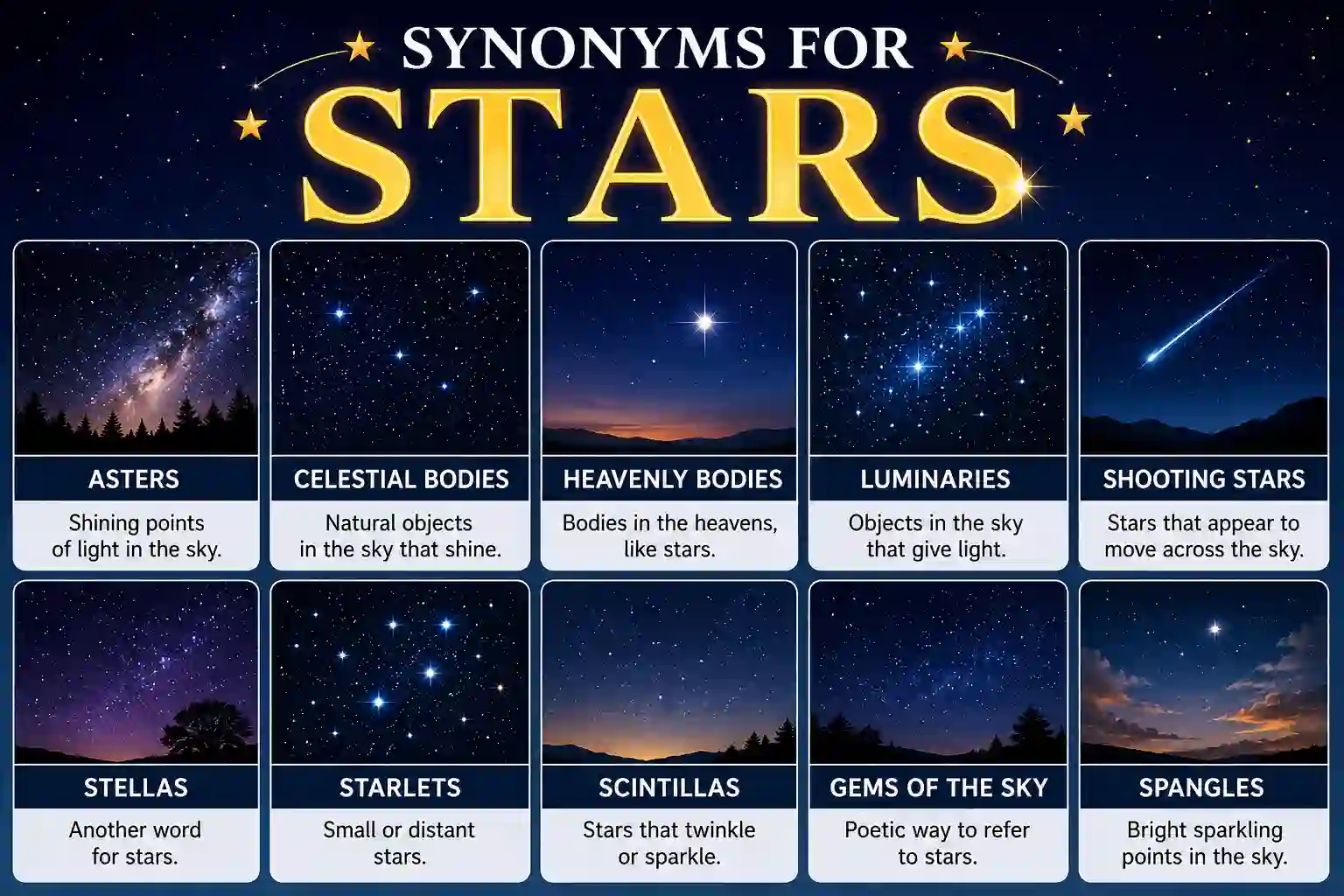
Some useful synonyms for stars include celestial bodies, suns, luminaries, heavenly bodies, celestial objects, stellar bodies, star systems, constellations, fixed stars, night lights, and cosmic objects.
Parts of Speech
| Word | Part of Speech | Simple Meaning |
| Stars | Noun | Bright objects that produce light in space |
| Sun | Noun | A star that gives light and heat |
| Luminary | Noun | A bright object in the sky |
| Celestial Body | Noun | A natural object in space |
| Heavenly Body | Noun | An object seen in the sky or space |
| Stellar Body | Noun | An object related to a star |
| Constellation | Noun | A named pattern of stars |
| Star System | Noun | A group of stars linked by gravity |
| Fixed Star | Noun | A star that appears fixed in the sky |
| Cosmic Object | Noun | An object found in outer space |
Main Content – 30 Synonyms for Stars
1. Celestial Bodies
Meaning: Celestial bodies are natural objects found in space.
Examples:
- Stars are some of the most beautiful celestial bodies.
- Scientists study many celestial bodies in space.
2. Suns
Meaning: Suns are stars that produce their own light and heat.
Examples:
- Some galaxies contain billions of suns.
- Distant suns can look like tiny points of light.
3. Luminaries
Meaning: Luminaries are bright objects that give off or reflect light.
Examples:
- The night sky was filled with bright luminaries.
- Ancient people watched the luminaries above them.
4. Heavenly Bodies
Meaning: Heavenly bodies are natural objects found in the sky or outer space.
Examples:
- The telescope helps us study heavenly bodies.
- Stars and planets are common heavenly bodies.
5. Celestial Objects
Meaning: Celestial objects are objects that exist in outer space.
Examples:
- The telescope captured several celestial objects.
- Stars are important celestial objects for astronomers.
6. Stellar Bodies
Meaning: Stellar bodies are objects connected with or made of stars.
Examples:
- Scientists observed several stellar bodies.
- The telescope can detect distant stellar bodies.
7. Fixed Stars
Meaning: Fixed stars are stars that appear to stay in the same pattern in the sky.
Examples:
- Ancient sailors used fixed stars for navigation.
- The fixed stars seemed bright above the ship.
8. Star Systems
Meaning: Star systems are groups of stars that are held together by gravity.
Examples:
- Scientists discovered a new star system.
- Some star systems contain several planets.
9. Cosmic Objects
Meaning: Cosmic objects are natural objects found in the universe.
Examples:
- The telescope can detect distant cosmic objects.
- Stars are among the brightest cosmic objects.
10. Space Objects
Meaning: Space objects are things that exist beyond Earth in space.
Examples:
- Students learned about different space objects.
- The camera captured several space objects.
11. Night Lights
Meaning: Night lights is a poetic way to describe bright objects seen at night.
Examples:
- The stars looked like tiny night lights.
- Children enjoyed watching the night lights above the town.
12. Sky Lights
Meaning: Sky lights are bright objects or sources of light seen in the sky.
Examples:
- The sky lights appeared after sunset.
- We watched the sky lights from the garden.
13. Starry Lights
Meaning: Starry lights are the small points of light made by stars.
Examples:
- Starry lights covered the dark sky.
- We enjoyed the view of the starry lights.
14. Astral Bodies
Meaning: Astral bodies are objects that exist in space.
Examples:
- The book explains how astral bodies move.
- Stars are important astral bodies.
15. Stellar Objects
Meaning: Stellar objects are space objects related to stars.
Examples:
- Researchers studied distant stellar objects.
- The telescope found several unusual stellar objects.
16. Bright Points
Meaning: Bright points are small spots of light that can be seen in the sky.
Examples:
- Bright points appeared as the sky became dark.
- The children counted the bright points overhead.
17. Points of Light
Meaning: Points of light are small visible sources of light.
Examples:
- The stars looked like tiny points of light.
- Thousands of points of light filled the sky.
18. Star Clusters
Meaning: Star clusters are groups of stars that are close together in space.
Examples:
- The telescope showed a beautiful star cluster.
- Astronomers study star clusters to learn about stars.
19. Constellations
Meaning: Constellations are patterns of stars that have names.
Examples:
- We found several constellations in the night sky.
- Orion is one of the best-known constellations.
20. Stellar Lights
Meaning: Stellar lights are lights produced by stars.
Examples:
- Stellar lights filled the dark sky.
- The desert was bright under the stellar lights.
21. Cosmic Lights
Meaning: Cosmic lights are sources of light that come from space.
Examples:
- The camera recorded distant cosmic lights.
- The sky was filled with faint cosmic lights.
22. Starry Points
Meaning: Starry points are small visible spots made by stars.
Examples:
- Starry points appeared above the mountains.
- The painting showed hundreds of starry points.
23. Heavenly Lights
Meaning: Heavenly lights are bright objects that appear in the sky.
Examples:
- The poem describes the heavenly lights.
- We watched the heavenly lights after sunset.
24. Stellar Lights
Meaning: Stellar lights are glowing points produced by stars.
Examples:
- The valley looked beautiful beneath the stellar lights.
- The photographer captured the stellar lights clearly.
25. Starry Bodies
Meaning: Starry bodies is a descriptive phrase for objects that appear as stars or are related to them.
Examples:
- The story describes mysterious starry bodies.
- Children drew colorful starry bodies in art class.
26. Celestial Lights
Meaning: Celestial lights are lights that come from objects in space.
Examples:
- The desert offered a clear view of celestial lights.
- We watched the celestial lights from the rooftop.
27. Stellar Sources
Meaning: Stellar sources are objects in space that produce or release energy and light.
Examples:
- Astronomers studied distant stellar sources.
- The telescope detected several stellar sources.
28. Galactic Stars
Meaning: Galactic stars are stars that belong to a galaxy.
Examples:
- Our galaxy contains billions of galactic stars.
- Scientists study galactic stars to understand the Milky Way.
29. Distant Suns
Meaning: Distant suns are stars far away from Earth that look like tiny points of light.
Examples:
- The night sky was filled with distant suns.
- Ancient people wondered about distant suns.
30. Stellar Objects in the Sky
Meaning: Stellar objects in the sky are star-related objects that can be observed from Earth.
Examples:
- The lesson focused on stellar objects in the sky.
- We used a telescope to observe stellar objects in the sky.
Frequently Asked Questions About Synonyms for Stars
1. What is the simplest synonym for stars?
Suns can be used as a simple related word because our Sun is itself a star. However, stars remains the most common and exact word.
2. What is a scientific word for stars?
Celestial bodies, stellar objects, and astral bodies can be used in scientific or educational contexts, although they can include objects other than stars.
3. What is a poetic synonym for stars?
Luminaries, heavenly lights, night lights, and points of light can create a more poetic description.
4. Is a constellation a synonym for stars?
Not exactly. A constellation is a named pattern of stars seen from Earth, so it is related to stars but does not mean one star.
5. What is another word for stars in the sky?
You can use celestial bodies, heavenly bodies, luminaries, points of light, or distant suns, depending on the context.
6. Can I use these synonyms in academic writing?
Yes, but choose carefully. Celestial bodies, celestial objects, stellar objects, and star systems are better for academic or science writing.
7. Why should I learn synonyms for stars?
Learning related words gives you more choices in essays, stories, blogs, poems, and conversations. It can also make your writing more descriptive.
Conclusion
Learning synonyms for stars can make your writing more varied, clear, and creative. Words such as luminaries, celestial bodies, heavenly lights, and distant suns can add different shades of meaning. Students can use them in essays, bloggers can use them in nature content, and writers can use them in stories and poems. Practice these words in emails, essays, creative writing, and daily conversations. The right word can make a simple description much more interesting.

Habib Ullah is the founder of LanguagePilots, where he creates easy-to-understand English learning content to help students and professionals build confidence in communication.