A disciple is a person who follows the teachings or ideas of a teacher, leader, or religious figure.
Imagine a student who does more than attend a teacher’s lessons. The student studies the teacher’s ideas, follows the advice, and tries to live by those principles. That person can be called a disciple.
The word disciple usually refers to someone who follows a person’s teachings with loyalty and commitment. It is common in religious writing, but it can also describe followers of famous teachers, thinkers, artists, or political leaders. (Cambridge Dictionary)
Learning synonyms for disciples helps English learners choose words that fit different situations. A writer may need a formal word such as adherent, a religious word such as devotee, or a general word such as follower. This article explains the meaning, history, pronunciation, word formation, and 30 useful synonyms of disciple.
Meaning of Disciple
Definition
Disciple (noun): a person who believes in and follows the teachings or ideas of a teacher, leader, or religious figure. (Oxford Learner’s Dictionaries)
Examples
- She became a devoted disciple of the spiritual teacher.
- The philosopher had many disciples who continued his work.
Connotative Meaning
- Positive tone: It can suggest loyalty, dedication, learning, and respect for a teacher or leader.
- Negative tone: In some contexts, it may suggest that someone follows another person too closely without independent thinking.
- Neutral tone: It can simply describe a person who follows and learns from a particular teacher or set of ideas.
(Connotation means the feeling or extra idea that a word can suggest beyond its basic meaning.)
Etymology
The word disciple comes through Old English discipul from Latin discipulus, meaning “learner,” “pupil,” or “student.” Latin discere means “to learn.” The history of the deeper Latin formation is debated, so it is safer not to assign a single certain root beyond the well-attested connection with learning.
The basic idea behind the word is therefore connected with learning from another person.
Short History
- Old English (450–1100): Old English had discipul, used especially in Christian contexts. The concept of a learner or follower could also be expressed with native terms such as leorningcniht. (Etymology Online)
- Middle English (1100–1500): French influence helped reinforce forms such as deciple or desciple. English religious vocabulary was strongly influenced by Latin and French during this period.
- Modern English (1500–Present): The word continued to be used for followers of Jesus and later developed a broader figurative use for devoted followers of teachers, thinkers, schools of thought, and other influential figures. (Oxford Learner’s Dictionaries)
Pronunciation (US & UK, IPA)
- US: /dɪˈsaɪ.pəl/
- UK: /dɪˈsaɪ.pəl/ (Cambridge Dictionary)
Syllables
- dis-ci-ple
Affixation Pattern of Disciple
- Root: discipul-, from Latin discipulus, meaning “learner” or “pupil.”
- Prefix: none in the modern English word.
- Suffix: none as a productive English suffix. The final part comes from the historical Latin form rather than a modern English suffix. (Oxford Learner’s Dictionaries)
The word should therefore not be analyzed as a modern English combination such as prefix + root + suffix.
Word Formation
- Disciple (noun): a person who follows the teachings of another.
- Discipleship (noun): the state or position of being a disciple. (Collins Dictionary)
- Discipular (adjective): relating to a disciple or discipleship. (Collins Dictionary)
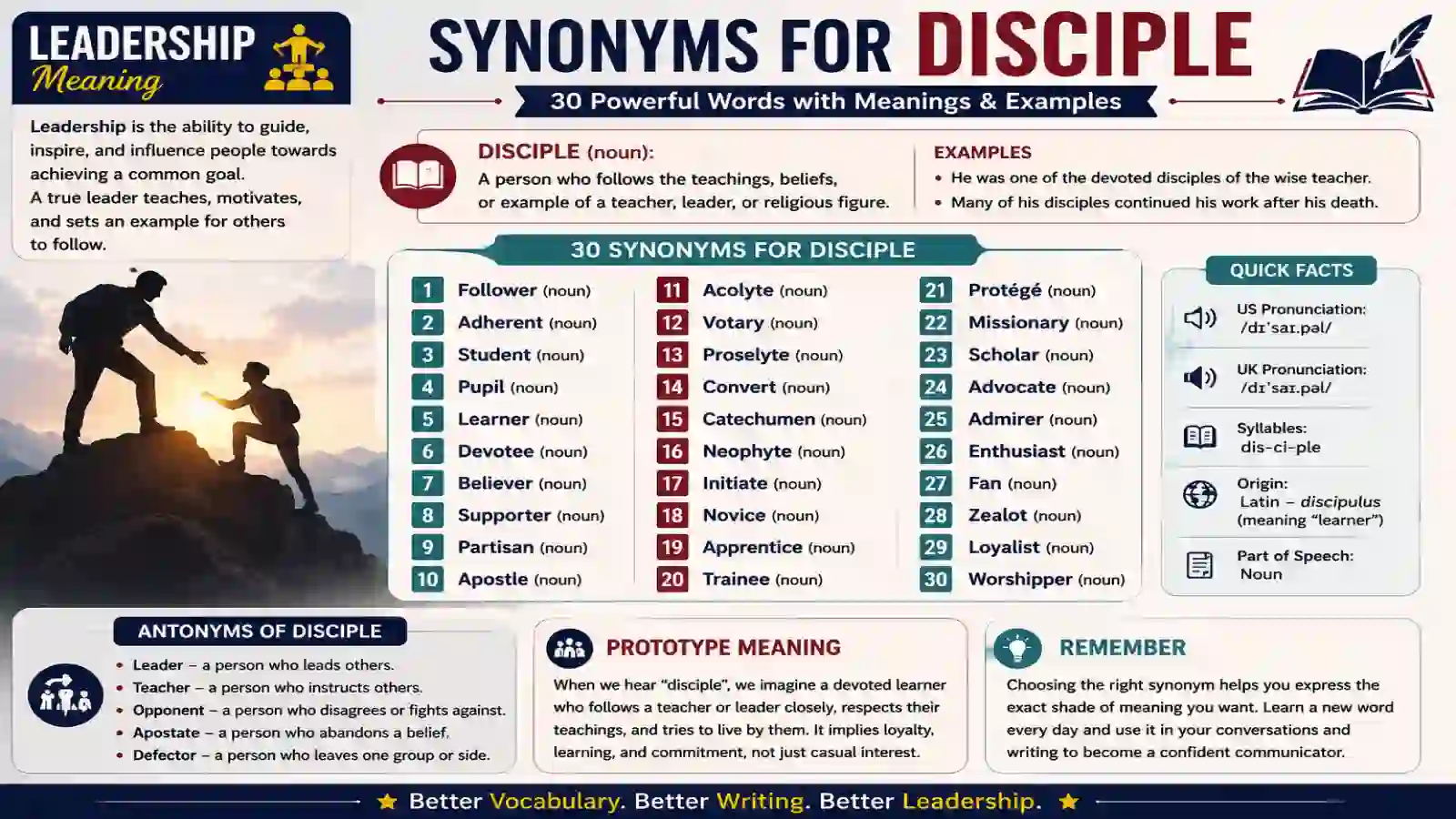
A List of 30 Synonyms for Disciple
The words below are dictionary-supported synonyms or close contextual equivalents of disciple. They do not all have exactly the same meaning. Some emphasize learning, some loyalty, and others religious commitment or strong support. Collins and Merriam-Webster both list many of these words in their synonym sets for disciple. (Collins Dictionary)
1. Follower (noun)
US /ˈfɑː.loʊ.ɚ/ | UK /ˈfɒl.əʊ.ə/
Meaning: A follower is a person who supports, admires, or follows another person or their ideas.
Examples:
Many followers of the teacher attended his public lectures.
She became a follower of the philosopher’s ideas after reading his books.
2. Adherent (noun)
US /ədˈhɪr.ənt/ | UK /ədˈhɪə.rənt/
Meaning: An adherent is a person who strongly supports a particular belief, person, or set of ideas.
Examples:
He was a strong adherent of the reformer’s philosophy.
The movement gained many new adherents during the decade.
3. Student (noun)
US /ˈstuː.dənt/ | UK /ˈstjuː.dənt/
Meaning: A student is a person who learns from a teacher or studies a subject.
Examples:
She was a dedicated student of the ancient philosopher.
The artist treated every young learner as a student of his craft.
Cambridge gives student a broad sense that can include someone who studies or takes a deep interest in a subject. (Cambridge Dictionary)
4. Pupil (noun)
US /ˈpjuː.pəl/ | UK /ˈpjuː.pəl/
Meaning: A pupil is a person who learns from a teacher or instructor.
Examples:
The master painter had several talented pupils.
His pupils carefully copied the techniques he taught them.
The word pupil is especially useful when the relationship between teacher and learner is important. (Cambridge Dictionary)
5. Learner (noun)
US /ˈlɜːr.nər/ | UK /ˈlɜː.nə/
Meaning: A learner is someone who is gaining knowledge or skill.
Examples:
The young learner studied the teacher’s method every morning.
As a learner, she asked many questions about his philosophy.
6. Devotee (noun)
US /ˌdev.əˈtiː/ | UK /ˌdev.əˈtiː/
Meaning: A devotee is a person who is very devoted to a person, belief, religion, or activity.
Examples:
The spiritual leader attracted many devoted devotees.
He became a devotee of the writer’s ideas.
Devotees often carry a stronger sense of dedication than the more general word follower. Its pronunciation is the same in standard US and UK English. (Cambridge Dictionary)
7. Believer (noun)
US /bɪˈliː.vər/ | UK /bɪˈliː.və/
Meaning: A believer is a person who accepts and has faith in a particular idea, religion, or teaching.
Examples:
She was a firm believer in her teacher’s principles.
The leader spoke to a large group of believers.
8. Supporter (noun)
US /səˈpɔːr.t̬ɚ/ | UK /səˈpɔː.tə/
Meaning: A supporter is a person who agrees with and gives help or approval to someone or something.
Examples:
He became a strong supporter of the professor’s educational ideas.
The reformer had supporters in several universities.
Support is broader than discipline because a supporter does not always learn from or follow a teacher.
9. Partisan (noun)
US /ˈpɑːr.t̬ə.zən/ | UK /ˈpɑː.tɪ.zæn/
Meaning: A partisan is a strong and often loyal supporter of a person, group, or cause.
Examples:
The writer was a partisan of the new school of thought.
Political partisans defended the leader’s ideas.
10. Apostle (noun)
US /əˈpɑː.səl/ | UK /əˈpɒs.əl/
Meaning: An apostle is an important religious follower or a strong supporter of a belief or movement.
Examples:
The early apostles traveled widely to spread their message.
He was known as an apostle of peace and social reform.
The apostle has a specific Christian meaning and can also describe a strong supporter of a cause.
READ More: 30 Synonyms of Follower with Examples & Explanation
11. Acolyte (noun)
US /ˈæk.ə.laɪt/ | UK /ˈæk.ə.laɪt/
Meaning: An acolyte is a follower or helper of an important person, especially in a religious setting.
Examples:
The professor’s acolytes continued his research after his retirement.
Several acolytes helped the priest prepare for the ceremony.
Acolyte can suggest both following and helping, and it is often formal or religious. (Cambridge Dictionary)
12. Votary (noun)
US /ˈvoʊ.t̬ər.i/ | UK /ˈvəʊ.tər.i/
Meaning: A votary is a person devoted to a religion, god, cause, or person.
Examples:
The temple attracted many devoted votaries.
He was a votary of strict environmental protection.
Votary is formal and often connected with religious devotion or strong support. (Cambridge Dictionary)
13. Proselyte (noun)
US /ˈprɑː.sə.laɪt/ | UK /ˈprɒs.ə.laɪt/
Meaning: A proselyte is a person who has accepted a new religious or political belief.
Examples:
The teacher welcomed every new proselyte to the community.
The movement attracted several young proselytes.
Proselyte focuses on someone who has changed to a new belief rather than simply following a teacher. (Cambridge Dictionary)
14. Convert (noun)
US /ˈkɑːn.vɝːt/ | UK /ˈkɒn.vɜːt/
Meaning: A convert is a person who has changed to a new religion, belief, or way of thinking.
Examples:
The new convert studied the teachings with great interest.
She became a convert after years of studying philosophy.
As a synonym for disciple, convert is most suitable when the person’s change of belief is important.
15. Catechumen (noun)
US /ˌkæt.əˈkjuː.mən/ | UK /ˌkæt.ɪˈkjuː.mən/
Meaning: A catechumen is a person receiving instruction before joining a Christian church.
Examples:
The catechumen attended weekly lessons about the faith.
Several catechumens studied the basic teachings before baptism.
16. Neophyte (noun)
US /ˈniː.ə.faɪt/ | UK /ˈniː.ə.faɪt/
Meaning: A neophyte is a person who is new to a belief, activity, or group.
Examples:
The new neophyte spent months learning the group’s traditions.
As a religious neophyte, he asked many basic questions.
Neophyte emphasizes newness more than discipline, so it is best used when someone is at an early stage of following a teaching.
17. Initiate (noun)
US /ɪˈnɪʃ.i.ət/ | UK /ɪˈnɪʃ.i.ət/
Meaning: An initiate is a person who has recently been accepted into a group or introduced to special knowledge.
Examples:
Each initiate received lessons from an experienced teacher.
The new initiate learned the group’s customs slowly.
18. Novice (noun)
US /ˈnɑː.vɪs/ | UK /ˈnɒv.ɪs/
Meaning: A novice is a person who is new to a subject, activity, or area of knowledge.
Examples:
The novice followed the master’s instructions carefully.
Even a novice could understand the teacher’s simple method.
19. Apprentice (noun)
US /əˈpren.tɪs/ | UK /əˈpren.tɪs/
Meaning: An apprentice is a person who learns a skill or trade from a more experienced person.
Examples:
The young apprentice watched the craftsman work.
Her apprentice learned the technique through daily practice.
Apprentice is closest to disciple when the relationship centers on practical training.
20. Trainee (noun)
US /ˌtreɪˈniː/ | UK /ˌtreɪˈniː/
Meaning: A trainee is a person who is being taught how to do a particular job or activity.
Examples:
Each trainee followed the instructor’s method.
The young trainee improved quickly under the expert’s guidance.
READ More: 30 Synonyms of Adherent with Examples & Explanation
21. Protégé (noun)
US /ˈproʊ.tə.ʒeɪ/ | UK /ˈprəʊ.tə.ʒeɪ/
Meaning: A protégé is a person whose work and development are supported by an experienced teacher or mentor.
Examples:
The famous painter helped his protégé develop a unique style.
Her protégé later became a respected scholar.
A protégé is usually connected to a mentor who actively supports the person’s development.
22. Missionary (noun)
US /ˈmɪʃ.ə.ner.i/ | UK /ˈmɪʃ.ən.ər.i/
Meaning: A missionary is a person who teaches or spreads a religious belief to others.
Examples:
The missionary traveled to distant villages to teach his faith.
Several missionaries worked together to build a new school.
Missionary overlaps with disciples in religious contexts but focuses more on spreading a belief.
23. Scholar (noun)
US /ˈskɑː.lɚ/ | UK /ˈskɒl.ər/
Meaning: A scholar is a person who studies a subject deeply and carefully.
Examples:
She became a respected scholar of the philosopher’s work.
The scholar spent years studying the teacher’s writings.
Scholar is a closer match when disciple means a serious student rather than a religious follower.
24. Advocate (noun)
US /ˈæd.və.kət/ | UK /ˈæd.və.kət/
Meaning: An advocate is a person who publicly supports a belief, idea, or cause.
Examples:
He became an advocate of the teacher’s educational reforms.
The writer was a strong advocate for equal access to education.
An advocate supports an idea, but the word does not always imply a teacher-student relationship.
25. Admirer (noun)
US /ədˈmaɪr.ɚ/ | UK /ədˈmaɪə.rə/
Meaning: An admirer is a person who respects, likes, or has a high opinion of someone.
Examples:
The author had many admirers among young writers.
She was an admirer of the professor’s work.
Admirer is weaker than disciple because admiration does not necessarily mean following someone’s teachings.
26. Enthusiast (noun)
US /ɪnˈθuː.zi.æst/ | UK /ɪnˈθjuː.zi.æst/
Meaning: An enthusiast is a person who shows strong interest and excitement about a subject or activity.
Examples:
He was an enthusiast of the new philosophical movement.
The teacher attracted many young enthusiasts.
Enthusiast emphasizes strong interest, while discipline emphasizes following or learning.
27. Fan (noun)
US /fæn/ | UK /fæn/
Meaning: A fan is a person who strongly likes or supports someone or something.
Examples:
She became a fan of the writer after reading his first book.
Many fans followed the teacher’s lectures online.
Fan is informal and usually less serious than disciple.
28. Zealot (noun)
US /ˈzel.ət/ | UK /ˈzel.ət/
Meaning: A zealot is a person who strongly and sometimes excessively supports a belief or cause.
Examples:
The movement attracted a few political zealots.
He was described as a zealot for strict environmental reform.
Zealot is stronger and can have a negative tone because it may suggest extreme devotion. (Cambridge Dictionary)
29. Loyalist (noun)
US /ˈlɔɪ.ə.lɪst/ | UK /ˈlɔɪ.ə.lɪst/
Meaning: A loyalist is a person who remains strongly loyal to a leader, government, or cause.
Examples:
The leader’s loyalists continued to defend his ideas.
Several loyalists supported the old school of thought.
Loyalists emphasize loyalty more than learning or teaching.
30. Worshipper (noun)
US /ˈwɝː.ʃɪ.pɚ/ | UK /ˈwɜː.ʃɪ.pə/
Meaning: A worshipper is a person who worships a god or takes part in religious worship.
Examples:
The worshippers gathered quietly before the ceremony.
Many worshippers followed the religious teacher’s instructions.
Worshipper is mainly religious and is more specific than the general word disciple.
Prototype Meaning
When native speakers hear a disciple, they often picture a devoted learner standing close to a respected teacher or spiritual leader. The typical image is someone who listens carefully, accepts important teachings, and tries to follow the teacher’s example. The word does not necessarily mean a blind follower or an extreme believer. In many contexts, it simply suggests a serious learner with strong loyalty to a particular teacher, philosophy, or religious tradition.
Prototype Categorization
- General followers: follower, adherent, supporter, partisan, loyalist
- Learners and students: student, pupil, learner, scholar, apprentice, trainee
- Devoted religious followers: devotee, believer, votary, worshipper, acolyte
- New or developing followers: proselyte, convert, catechumen, neophyte, initiate, novice
- Strong supporters: advocate, admirer, enthusiast, fan, champion
- Religious or historical roles: apostle, missionary
Grouping synonyms by meaning helps writers choose the right word instead of treating every synonym as identical. For example, a student emphasizes learning, a devotee emphasizes dedication, and an apostle carries a strong religious or historical sense.
Antonyms of Disciple
- Leader (noun): a person who guides or directs other people.
- Teacher (noun): a person who gives knowledge or instruction to others.
- Opponent (noun): a person who disagrees with or acts against someone or something.
- Apostate (noun): a person who abandons a religious or political belief they once followed.
- Defector (noun): a person who leaves one group or side and joins another.
Merriam-Webster identifies words such as leader, traitor, renegade, defector, and apostate among antonyms or near-antonyms of disciple.
Short Questions and Answers
- What does disciple mean?
A disciple is a person who follows and learns from the teachings of a teacher, leader, or religious figure. - When should disciple be used?
Use discipline when someone follows a person’s teachings or philosophy with meaningful loyalty. It is common in religious and intellectual contexts. - Is discipline positive or negative?
The word is usually neutral or positive. It can suggest dedication and respect, but in some contexts it may imply excessive dependence on a leader. - How is it different from similar words?
The follower is broader, the student emphasizes learning, and devotee emphasizes strong dedication. The apostle has a more specific religious or historical meaning.
Conclusion
Learning a disciple and its synonyms can make your English more precise. Instead of using follower every time, you can choose adherent, student, devotee, apostle, or another word that matches the exact situation. These differences are useful in essays, academic writing, religious discussions, articles, and everyday communication. Understanding the shades of meaning also helps you avoid repetition and speak with greater confidence. Keep practicing by using one new synonym in a sentence each day.

Habib Ullah is the founder of LanguagePilots, where he creates easy-to-understand English learning content to help students and professionals build confidence in communication.