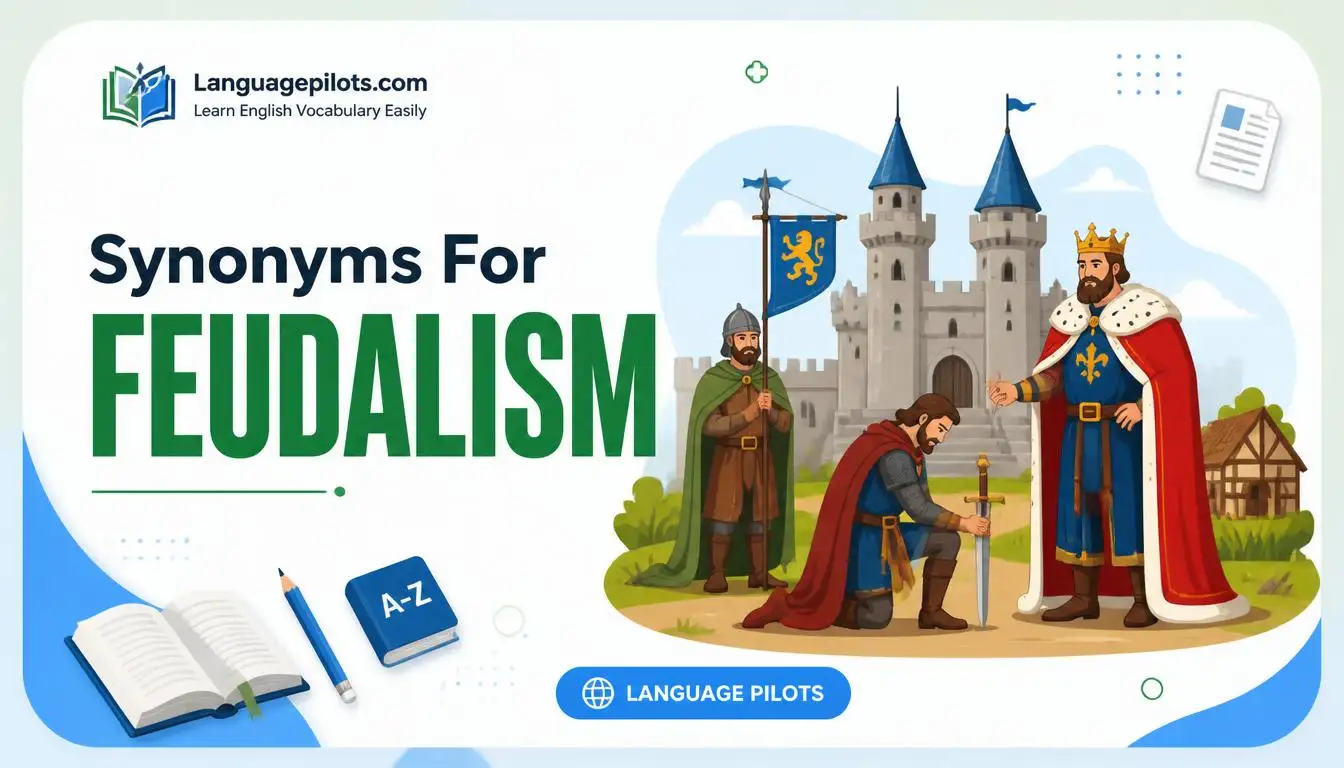
Have you ever wondered how people lived in a society where land, power, and protection were controlled by a small group of powerful people? This was common in feudalism, especial in medieval Europe. In a feudal system, powerful landowners gave land to others in return for work, loyalty, or military service. For example, a lord could give land to a night, while peasants worked on that land. In simple English, feudalism is a social and political system based on land, loyalty, and service. Learning synonyms for feudalism helps students understand history and write better essays. Bloggers and content writers can use related terms to avoid repetition. Daily English users can also understand historical and political discussions more easily. Knowing synonyms for feudalism makes vocabulary clearer and more useful.
Quick Answer: Synonyms for Feudalism
Some useful synonyms and closely related terms for feudalism are:
Manorialism, lordship, vassalage, serfdom, land tenure, feudal system, feudal society, medieval hierarchy, aristocracy, landlordism, agrarian hierarchy, social hierarchy, class system, caste system, hereditary rule, landed aristocracy, land-based society, noble rule, estate system, decentralized rule, patronage system, dependent labor, bonded labor, and medieval social order.
Note: Feudalism is a specific historical system, so many of these terms are related words rather than exact synonyms. Their meanings can change depending on the historical context.
Parts of Speech
| Word | Part of Speech | Simple Meaning |
| Feudalism | Noun | A system based on land, loyalty, and service |
| Manorialism | Noun | A system based on large landed estates |
| Lordship | Noun | Control or authority held by a lord |
| Vassalage | Noun | A relationship of loyalty and service |
| Serfdom | Noun | A system where workers were tied to the land |
| Land tenure | Noun phrase | The way land is held or owned |
| Feudal system | Noun phrase | A social system based on land and service |
| Feudal society | Noun phrase | A society organized around feudal relationships |
| Medieval hierarchy | Noun phrase | A ranked social structure in medieval times |
| Aristocracy | Noun | A powerful upper social class |
| Landlordism | Noun | A system based on landowners controlling land |
| Agrarian hierarchy | Noun phrase | A social ranking based on land and farming |
| Social hierarchy | Noun phrase | A system that ranks people by status |
| Class system | Noun phrase | A society divided into social classes |
| Caste system | Noun phrase | A society divided into fixed social groups |
| Hereditary rule | Noun phrase | Power passed through a family |
| Landed aristocracy | Noun phrase | A wealthy noble class that owns land |
| Land-based society | Noun phrase | A society where land is a major source of power |
| Noble rule | Noun phrase | Government or control by nobles |
| Estate system | Noun phrase | A system organized around social estates |
| Decentralized rule | Noun phrase | A system where power is spread among local rulers |
| Patronage system | Noun phrase | A system based on support between powerful people and dependents |
| Dependent labor | Noun phrase | Work done by people who depend on another authority |
| Bonded labor | Noun phrase | Labor performed under a strong legal or social obligation |
| Medieval social order | Noun phrase | The social structure of medieval society |
1. Manorialism
Meaning:
Manorialism was a medieval system based on large estates controlled by landowners.
Examples:
- Manorialism shaped life in many medieval villages.
- Farmers worked on estates under manorialism.
2. Lordship
Meaning:
Lordship means the power or control held by a lord.
Examples:
- The village was under the lordship of a local noble.
- His lordship covered several large estates.
3. Vassalage
Meaning:
Vassalage was a relationship in which a person served a powerful lord in return for protection or land.
Examples:
- Vassalage created strong ties between lords and knights.
- The knight entered vassalage with the local ruler.
4. Serfdom
Meaning:
Serfdom was a system in which workers were tied to the land they worked on.
Examples:
- Serfdom limited the freedom of many medieval workers.
- The history class discussed the hardships of serfdom.
5. Land Tenure
Meaning:
Land tenure means the way a person or group holds or uses land.
Examples:
- Medieval land tenure often depended on loyalty to a lord.
- The historian studied changes in land tenure.
6. Feudal System
Meaning:
The feudal system was a social system based on land, loyalty, protection, and service.
Examples:
- The feudal system shaped medieval political life.
- Students learned how the feudal system worked.
7. Feudal Society
Meaning:
Feudal society was a society organized around lords, vassals, land, and service.
Examples:
- Life in feudal society was strongly divided by social rank.
- The book describes daily life in feudal society.
8. Medieval Hierarchy
Meaning:
Medieval hierarchy was the ranked social structure of medieval society.
Examples:
- Medieval hierarchy placed nobles above peasants.
- The teacher explained the medieval hierarchy with a simple chart.
9. Aristocracy
Meaning:
Aristocracy means a powerful upper class, often made up of nobles.
Examples:
- The aristocracy owned much of the land.
- Many members of the aristocracy lived in large castles.
10. Landlordism
Meaning:
Landlordism means a system in which landowners have strong control over land and its users.
Examples:
- Landlordism gave wealthy landowners great influence.
- The reform aimed to reduce the power of landlordism.
11. Agrarian Hierarchy
Meaning:
Agrarian hierarchy means a social ranking based mainly on land ownership and farming.
Examples:
- The agrarian hierarchy gave landowners more power.
- Farmers had a low place in the agrarian hierarchy.
12. Social Hierarchy
Meaning:
Social hierarchy means a system in which people have different levels of status or power.
Examples:
- The social hierarchy was easy to see in the old kingdom.
- Wealth often affects a person’s place in the social hierarchy.
13. Class System
Meaning:
A class system is a society divided into groups based on social or economic position.
Examples:
- The class system affected people’s daily lives.
- The novel shows how the class system worked.
14. Caste System
Meaning:
A caste system is a social structure that places people into fixed social groups.
Examples:
- The caste system shaped many parts of traditional society.
- People could face limits because of the caste system.
15. Hereditary Rule
Meaning:
Hereditary rule means power is passed from one family member to another.
Examples:
- Hereditary rule kept power within the royal family.
- The kingdom followed a system of hereditary rule.
16. Landed Aristocracy
Meaning:
Landed aristocracy means a wealthy noble class that gains power from owning land.
Examples:
- The landed aristocracy controlled large estates.
- The king relied on the landed aristocracy for support.
17. Land-Based Society
Meaning:
A land-based society is a society where land is a major source of wealth and power.
Examples:
- Medieval Europe was largely a land-based society.
- A land-based society often gives landowners great influence.
18. Noble Rule
Meaning:
Noble rule means control or government by members of the noble class.
Examples:
- Noble rule was common in parts of medieval Europe.
- The people lived under noble rule for many years.
19. Estate System
Meaning:
The estate system was a social structure divided into major social groups or estates.
Examples:
- The estate system gave different groups different rights.
- Students studied the estate system in history class.
20. Decentralized Rule
Meaning:
Decentralized rule means political power is spread among many local rulers.
Examples:
- Decentralized rule made the kingdom harder to control.
- Local lords gained power under decentralized rule.
21. Patronage System
Meaning:
A patronage system is a system where powerful people give support or benefits in return for loyalty.
Examples:
- The ruler used a patronage system to gain support.
- The patronage system connected powerful families.
22. Dependent Labor
Meaning:
Dependent labor means work done by people who rely on another person or authority.
Examples:
- The estate depended on dependent labor.
- Dependent labor was common on some medieval estates.
23. Bonded Labor
Meaning:
Bonded labor means work performed because a person has a strong legal or social obligation.
Examples:
- Bonded labor restricted workers’ freedom.
- The law later placed limits on bonded labor.
24. Medieval Social Order
Meaning:
Medieval social order means the way medieval society was organized into different ranks and groups.
Examples:
- The medieval social order placed nobles above common workers.
- Religion was important in the medieval social order.
25. Feudal Structure
Meaning:
Feudal structure means the organized system of ranks, land, duties, and relationships found in feudal society.
Examples:
- The feudal structure connected land ownership with political power.
- The king stood at the top of the feudal structure.
How to Choose the Right Synonym for Feudalism
The best related word depends on what part of feudalism you want to describe.
Use manorialism when talking about the economic system of medieval estates.
vassalage when discussing loyalty and service between a lord and a vassal.
serfdom when focusing on the condition of peasants tied to the land.
aristocracy when discussing the powerful noble class.
landed aristocracy when the main focus is wealthy nobles who owned large areas of land.
hereditary rule when power passes through families.
social hierarchy when you want to describe the ranked structure of society.
decentralized rule when focusing on how political power was spread among local rulers.
land-based society when explaining how land created wealth and power.
Feudalism vs. Manorialism
Feudalism and manorialism are related but are not exactly the same.
Feudalism mainly describes political, military, and social relationships involving lords, vassals, land, loyalty, and service.
Manorialism focuses more on the economic organization of a manor or large estate. It explains how land was managed and how people worked on it.
In simple terms, feudalism is more about relationships and power, while manorialism is more about estates and economic life.
Feudalism vs. Serfdom
Feudalism describes a broad social and political system.
Serfdom describes the condition of people who were tied to the land and had limited freedom.
Serfdom existed in some feudal societies, but the two words should not be treated as exact synonyms.
Feudalism vs. Aristocracy
Aristocracy refers to a powerful upper social class, often made up of nobles.
Feudalism refers to a wider system of social, political, and economic relationships.
A feudal society could contain an aristocracy, but aristocracy itself does not mean feudalism.
Why Learning Synonyms for Feudalism Matters
Learning related vocabulary helps you understand history more clearly.
Students can use words such as manorialism, vassalage, and serfdom in history essays and exams.
Bloggers can use related terms to make historical articles more natural.
Content writers can choose precise words instead of repeating feudalism many times.
English learners can also understand books, documentaries, and history lessons more easily.
The key is to remember that many of these terms are related concepts, not perfect replacements for feudalism.
Frequently Asked Questions
1. What is the simplest synonym for feudalism?
There is no perfect one-word synonym for feudalism. Feudal system is the closest simple alternative, while terms such as manorialism and vassalage describe specific parts of the system.
2. What does feudalism mean in simple English?
Feudalism was a system where land, power, loyalty, protection, and service were closely connected. Powerful landowners gave land to others in return for service or loyalty.
3. Is manorialism the same as feudalism?
No. Manorialism mainly describes the economic life of large medieval estates. Feudalism has a broader meaning and includes political and social relationships.
4. Is serfdom a synonym for feudalism?
No. Serfdom was a condition in which people were tied to land and had limited freedom. It was associated with some feudal societies but does not mean the whole feudal system.
5. What is the opposite of feudalism?
There is no single exact opposite. Depending on the context, possible contrasts include democracy, social equality, centralized government, free labor, and modern capitalism.
6. What are the main features of feudalism?
Common features include land ownership, social ranks, powerful lords, vassals, obligations, military service, and agricultural labor. The exact form of feudalism varied across places and periods.
7. Why are synonyms for feudalism useful for students?
They help students understand different parts of the system and avoid repeating the same word in history essays. Words such as vassalage, manorialism, serfdom, and aristocracy add precision to historical writing.
Conclusion
Learning synonyms for feudalism helps improve writing, blogging, speaking, and communication. Words such as manorialism, vassalage, serfdom, aristocracy, and social hierarchy can help you describe different parts of this historical system. Practice these terms in emails, essays, notes, and daily conversations. Understanding the small differences between related words will make your English stronger and your writing more precise.

Habib Ullah is the founder of LanguagePilots, where he creates easy-to-understand English learning content to help students and professionals build confidence in communication.