
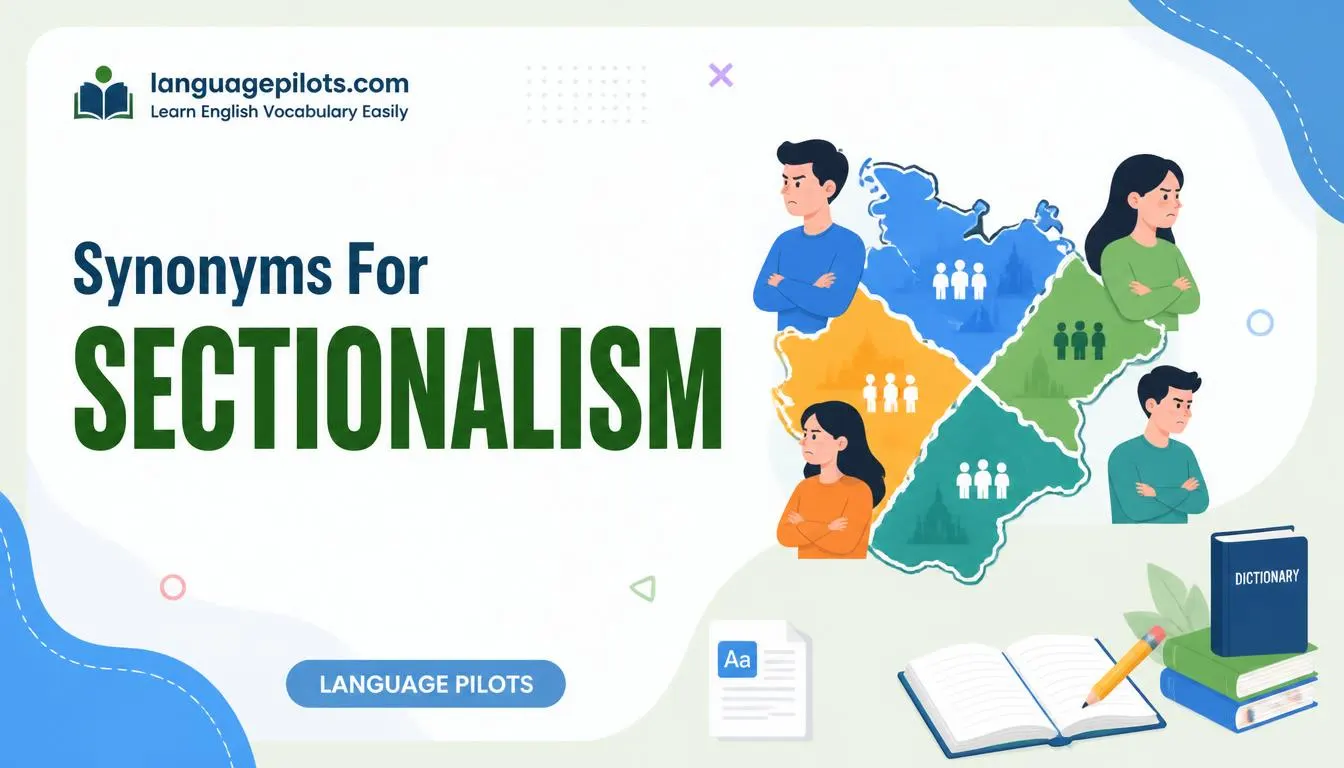
Have you ever seen people support their own group while ignoring the needs of others? This is a simple example of sectionalism. Sectionalism happens when people give strong support to one region, group, class, or section instead of thinking about everyone as a whole.
For example, people in different regions of a country may disagree because each region wants its own interests to come first. This is called sectionalism.
In simple English, sectionalism means strong loyalty to one group or area over the larger community. Learning synonyms for sectionalism helps you describe this idea in different ways. Students can use these words in essays and exams. Bloggers and content writers can avoid repeating the same word. Daily English users can also choose the right word for different situations.
Understanding synonyms for sectionalism can make your writing clearer, more natural, and more precise.
Quick Answer: Synonyms for Sectionalism
Some useful synonyms and related words for sectionalism include:
Regionalism, factionalism, partisanship, group loyalty, localism, provincialism, separatism, division, disunity, tribalism, sectarianism, parochialism, insularity, exclusiveness, favoritism, bias, partiality, narrow-mindedness, groupism, polarization, fragmentation, rivalry, self-interest, special interest, class division, regional loyalty, factional loyalty, group division, social division, and internal division.
Parts of Speech
| Word | Part of Speech | Simple Meaning |
| Sectionalism | Noun | Strong loyalty to one section or group |
| Regionalism | Noun | Strong loyalty to a particular region |
| Factionalism | Noun | Conflict between groups within a larger group |
| Partisanship | Noun | Strong support for one side |
| Group loyalty | Noun phrase | Strong support for one’s own group |
| Localism | Noun | Strong focus on local interests |
| Provincialism | Noun | Limited interest beyond one’s own area |
| Separatism | Noun | Support for separation from a larger group |
| Division | Noun | A state of being split |
| Disunity | Noun | Lack of unity |
| Tribalism | Noun | Strong loyalty to one’s own group |
| Sectarianism | Noun | Strong loyalty to a religious or social group |
| Parochialism | Noun | Narrow focus on local concerns |
| Insularity | Noun | Limited interest in outside ideas |
| Exclusiveness | Noun | Keeping others outside a group |
| Favoritism | Noun | Unfair preference for one person or group |
| Bias | Noun | An unfair preference |
| Partiality | Noun | Preference for one side |
| Narrow-mindedness | Noun | Unwillingness to consider other views |
| Groupism | Noun | Strong focus on group interests |
| Polarization | Noun | Movement toward two opposing sides |
| Fragmentation | Noun | Breaking into smaller groups |
| Rivalry | Noun | Competition between groups |
| Self-interest | Noun | Focus on one’s own benefit |
| Special interest | Noun phrase | A strong concern for a particular group |
| Class division | Noun phrase | Separation between social classes |
| Regional loyalty | Noun phrase | Strong loyalty to a region |
| Factional loyalty | Noun phrase | Strong loyalty to a faction |
| Group division | Noun phrase | Separation between groups |
| Social division | Noun phrase | Separation within society |
1. Regionalism
Meaning:
Regionalism means strong support for the interests of a particular region.
Examples:
- Regionalism can affect how people vote in national elections.
- The debate showed strong regionalism between the two areas.
2. Factionalism
Meaning:
Factionalism means conflict between smaller groups inside a larger group.
Examples:
- Factionalism made the political party weaker.
- The club suffered from factionalism after the election.
3. Partisanship
Meaning:
Partisanship means strong support for one side, especially in politics.
Examples:
- Partisanship made it hard for the leaders to agree.
- The debate became full of partisanship.
4. Group Loyalty
Meaning:
Group loyalty means strong support for the group a person belongs to.
Examples:
- Group loyalty influenced his decision.
- Her group loyalty was clear during the competition.
5. Localism
Meaning:
Localism means giving strong attention to the needs of one’s local area.
Examples:
- Localism shaped the town’s new policies.
- The campaign focused on localism and community needs.
6. Provincialism
Meaning:
Provincialism means having a narrow view based mainly on one’s own area or community.
Examples:
- Provincialism can make people ignore wider problems.
- His provincialism was clear when he rejected outside ideas.
7. Separatism
Meaning:
Separatism means supporting the idea that a group or region should become separate.
Examples:
- Separatism became a major issue in the region.
- The movement was linked to growing separatism.
8. Division
Meaning:
Division means a state in which people or groups are separated from each other.
Examples:
- The argument created division among the members.
- Political division can slow down important decisions.
9. Disunity
Meaning:
Disunity means a lack of agreement or unity among people.
Examples:
- Disunity made the team less effective.
- The leader warned that disunity could hurt the organization.
10. Tribalism
Meaning:
Tribalism means strong loyalty to one’s own group over other groups.
Examples:
- Tribalism can make cooperation difficult.
- Social media sometimes increases tribalism between groups.
11. Sectarianism
Meaning:
Sectarianism means strong loyalty to one religious or social group over others.
Examples:
- Sectarianism can create serious social tension.
- The leaders spoke against sectarianism in the community.
12. Parochialism
Meaning:
Parochialism means focusing too much on local concerns and ignoring wider issues.
Examples:
- Parochialism can limit a person’s understanding of the world.
- The writer criticized the town’s political parochialism.
13. Insularity
Meaning:
Insularity means having little interest in people, ideas, or places outside one’s own group.
Examples:
- Insularity can prevent a community from learning new ideas.
- The manager wanted to reduce the company’s insularity.
14. Exclusiveness
Meaning:
Exclusiveness means keeping people outside a group or giving special value to members of that group.
Examples:
- The club was criticized for its exclusiveness.
- Social exclusiveness can make newcomers feel unwelcome.
15. Favoritism
Meaning:
Favoritism means giving unfair support to one person or group.
Examples:
- The manager was accused of favoritism at work.
- Favoritism can damage trust among employees.
16. Bias
Meaning:
Bias means an unfair preference for one person, group, or side.
Examples:
- The article showed a clear bias toward one region.
- Teachers should avoid bias when grading students.
17. Partiality
Meaning:
Partiality means giving more support to one side than another.
Examples:
- The judge was expected to show no partiality.
- His partiality toward his own team was obvious.
18. Narrow-Mindedness
Meaning:
Narrow-mindedness means being unwilling to accept different ideas or views.
Examples:
- Narrow-mindedness can stop people from learning.
- Her narrow-mindedness caused problems during the discussion.
19. Groupism
Meaning:
Groupism means putting the interests of one’s group above the interests of the larger community.
Examples:
- Groupism created tension among the workers.
- The school tried to prevent groupism among students.
20. Polarization
Meaning:
Polarization means a situation in which people become divided into two strongly opposing sides.
Examples:
- Political polarization made the discussion more difficult.
- The issue caused polarization across the community.
21. Fragmentation
Meaning:
Fragmentation means breaking into smaller groups or parts.
Examples:
- Fragmentation weakened the organization.
- The country faced political fragmentation after the crisis.
22. Rivalry
Meaning:
Rivalry means strong competition between people or groups.
Examples:
- Regional rivalry affected the sports event.
- The rivalry between the two groups lasted for years.
23. Self-Interest
Meaning:
Self-interest means focusing on what benefits oneself or one’s own group.
Examples:
- Self-interest influenced the group’s decision.
- Leaders must balance self-interest with public needs.
24. Special Interest
Meaning:
Special interest means a strong concern for the needs of a particular group.
Examples:
- The law was criticized for serving a special interest.
- The organization represents a special interest in the community.
25. Class Division
Meaning:
Class division means separation between groups of people based on social or economic class.
Examples:
- Class division can create unequal opportunities.
- The novel explores class division in the city.
26. Regional Loyalty
Meaning:
Regional loyalty means strong support for a particular region.
Examples:
- Regional loyalty influenced the election results.
- His regional loyalty was stronger than his national identity.
27. Factional Loyalty
Meaning:
Factional loyalty means strong support for one faction within a larger group.
Examples:
- Factional loyalty prevented the members from reaching an agreement.
- Her factional loyalty shaped her political choices.
28. Group Division
Meaning:
Group division means separation between different groups of people.
Examples:
- Group division made the workplace less friendly.
- The leader worked to reduce group division.
29. Social Division
Meaning:
Social division means separation between different groups within society.
Examples:
- Social division can weaken a community.
- Education can help reduce social division.
30. Internal Division
Meaning:
Internal division means disagreement or separation within a group or organization.
Examples:
- Internal division weakened the political movement.
- The team faced internal division after the disagreement.
How to Choose the Right Synonym for Sectionalism
The best synonym depends on the situation.
Use regionalism when the division is connected to geographical areas or regions.
factionalism when different groups inside the same organization or political movement are fighting.
partisanship when people strongly support one political side.
tribalism when people show strong loyalty to their own social or cultural group.
sectarianism when the division is connected to religious or sect-based groups.
separatism when a group wants to become politically or socially separate.
bias, partiality, or favoritism when the main idea is unfair preference.
polarization when society moves toward two opposing sides.
fragmentation when a larger group breaks into smaller groups.
Use disunity or division when you want a broad and simple word.
Sectionalism vs. Regionalism
Sectionalism focuses on strong loyalty to a particular section or group. The section can be based on geography, politics, class, or another interest.
Regionalism is more specific. It usually focuses on loyalty to a particular geographical region.
Example:
- Regionalism may cause people in one part of a country to support local interests.
- Sectionalism can include regional conflicts as well as other group-based divisions.
Sectionalism vs. Factionalism
Factionalism usually refers to conflict between smaller groups within a larger organization.
Sectionalism has a wider meaning. It can describe loyalty to a region, class, political group, or other section.
For example, a political party may experience factionalism when its members split into competing groups. A country may experience sectionalism when different regions put their own interests before national interests.
Sectionalism vs. Separatism
These words can appear in similar discussions, but they have different meanings.
Sectionalism means strong loyalty to a particular section.
Separatism goes further. It involves supporting separation from a larger political or social unit.
A group can show sectionalism without wanting to separate completely.
Why Learning Synonyms for Sectionalism Matters
Learning related words helps you choose a more precise language.
A student writing an essay may use regionalism instead of repeating sectionalism.
A blogger may use division, polarization, or groupism depending on the topic.
A content writer can use related vocabulary to make an article more natural.
English learners can also improve their speaking skills by understanding the differences between similar words.
The goal is not to replace sectionalism every time. The goal is to know which word fits the exact meaning.
Frequently Asked Questions
1. What is the simplest synonym for sectionalism?
Regionalism is one of the closest common synonyms when sectionalism refers to strong loyalty to a particular region. Other choices include groupism, division, and factionalism, depending on the context.
2. What does sectionalism mean in simple English?
Sectionalism means strongly supporting your own group or area instead of thinking about the interests of the larger community.
3. Is regionalism a synonym for sectionalism?
Regionalism can be a synonym for sectionalism when the division is based on geographical regions. However, sectionalism can have a wider meaning.
4. What is the opposite of sectionalism?
Possible opposites include unity, cooperation, inclusiveness, solidarity, national unity, and togetherness. The best opposite depends on the context.
5. What is a political synonym for sectionalism?
Useful political alternatives include regionalism, factionalism, partisanship, polarization, groupism, and special-interest politics. The correct choice depends on the type of political division.
6. Is factionalism the same as sectionalism?
No. Factionalism mainly describes conflict between factions within a larger group. Sectionalism is broader and can involve regions, social groups, political groups, or other sections.
7. How can I use sectionalism in a sentence?
You can say: “Sectionalism created disagreement between different regions of the country.” Another example is: “The leader warned that sectionalism could weaken national unity.”
Conclusion
Learning synonyms for sectionalism gives you more choices when writing and speaking. Words such as regionalism, factionalism, partisanship, tribalism, division, and polarization help you describe different forms of group-based conflict. These words can improve essays, blog posts, emails, and daily conversations. Practice using them in simple sentences. The more you use these words, the easier it becomes to choose the right word for every situation.

Habib Ullah is the founder of LanguagePilots, where he creates easy-to-understand English learning content to help students and professionals build confidence in communication.