
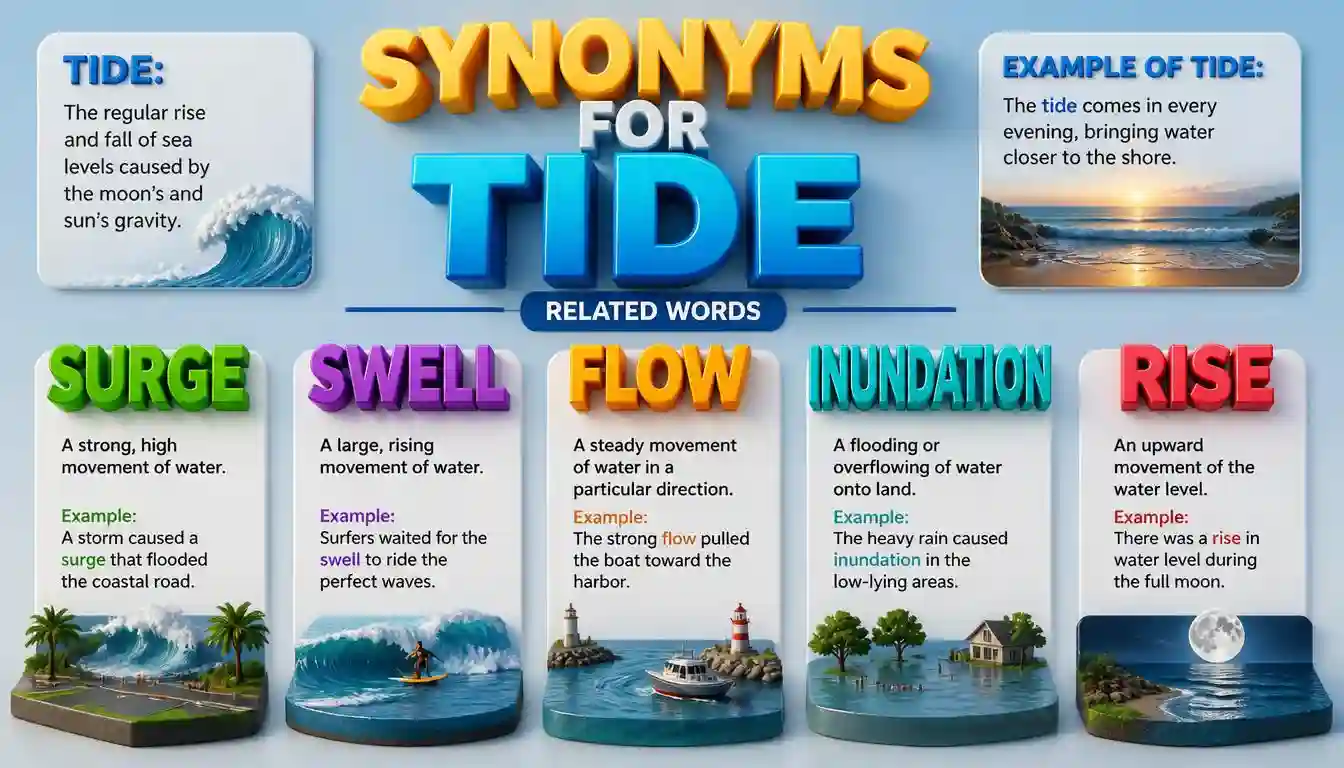
Have you ever stood near the sea and watched the water slowly rise or fall? That changing movement is called the tide. For example, the beach may look wide in the morning, but the water can move closer to the shore later in the day.
The word tide is mainly used for the regular rise and fall of ocean water. It can also have a figurative meaning, such as a growing movement, trend, or change. Learning synonyms for tide can help you describe movement, change, and rising or falling conditions more clearly.
Students can use related words in geography and science writing. Bloggers and content writers can avoid repeating the same terms. Daily English users can also understand expressions such as “the tide is turning” more easily.
Learning synonyms for tide is a useful way to build stronger English vocabulary.
Quick Answer
The closest synonyms for tide depend on the meaning. Useful related words include ebb, flow, current, surge, wave, swell, rise, fall, movement, trend, change, stream, drift, flood, and influx.
When talking about the sea, ebb and flow are especially useful. When using tide in a figurative sense, trend, movement, change, and shift may fit better.
Tide: Parts of Speech
| Word | Part of Speech | Simple Meaning |
| Tide | Noun | The regular rise and fall of sea water |
| Tide | Verb | To carry or move along |
| Tidal | Adjective | Related to tides |
| Tides | Noun | Repeated movements of sea water |
Main Content – Synonyms for Tide
1. Ebb
Meaning: Ebb means the movement of water away from the shore.
Examples:
- The tide began to ebb before sunset.
- We walked along the beach during the ebb.
2. Flow
Meaning: Flow means the movement of water in a steady direction.
Examples:
- The tide began to flow toward the shore.
- We watched the water flow around the rocks.
3. Current
Meaning: A current is a steady movement of water in one direction.
Examples:
- The boat moved with the ocean current.
- The strong current made swimming difficult.
4. Surge
Meaning: A surge is a sudden strong rise or movement of water.
Examples:
- A surge of water reached the harbor wall.
- The waves surged toward the shore.
5. Wave
Meaning: A wave is a moving rise of water on the sea or ocean.
Examples:
- A large wave reached the beach.
- The children jumped over the small waves.
6. Swell
Meaning: A swell is a long, smooth rise of ocean water.
Examples:
- The boat moved over a gentle swell.
- A large swell made the small boat rock.
7. Rise
Meaning: Rise means to move upward or become higher.
Examples:
- The sea level began to rise.
- We watched the water rise near the rocks.
8. Fall
Meaning: Fall means to move downward or become lower.
Examples:
- The water level began to fall.
- The tide will fall later this evening.
9. Movement
Meaning: Movement means the act of moving from one place or position to another.
Examples:
- The movement of the sea was easy to see.
- We studied the movement of the water.
10. Trend
Meaning: A trend is a general direction in which something is changing.
Examples:
- The new trend is growing quickly.
- The market trend changed this month.
11. Change
Meaning: Change means becoming different from before.
Examples:
- The weather brought a sudden change.
- We noticed a change in the water level.
12. Shift
Meaning: A shift is a change in position, direction, or condition.
Examples:
- There was a shift in the wind.
- The political mood showed a major shift.
13. Stream
Meaning: A stream is a steady flow of water.
Examples:
- A small stream ran toward the sea.
- The water moved like a gentle stream.
14. Drift
Meaning: Drift means to move slowly without strong control.
Examples:
- The boat began to drift toward the shore.
- Leaves drifted across the water.
15. Flood
Meaning: A flood is a large amount of water covering land that is usually dry.
Examples:
- The rising water caused a flood.
- The village prepared for a possible flood.
16. Influx
Meaning: An influx is a large number of people or things arriving at once.
Examples:
- The city saw an influx of tourists.
- The festival brought an influx of visitors.
17. Swarming
Meaning: Swarming means moving into a place in large numbers.
Examples:
- Fans came swarming into the stadium.
- Tourists were swarming around the old market.
18. Flowing
Meaning: Flowing means moving smoothly and continuously.
Examples:
- The river was flowing toward the sea.
- Water was flowing over the stones.
19. Motion
Meaning: Motion means movement from one place or position.
Examples:
- The ocean was in constant motion.
- We watched the motion of the waves.
20. Rhythm
Meaning: Rhythm is a regular pattern of movement or change.
Examples:
- The ocean has a natural rhythm.
- She noticed the rhythm of the waves.
21. Cycle
Meaning: A cycle is a repeated pattern that happens again and again.
Examples:
- The tides follow a natural cycle.
- The water changes through a regular cycle.
22. Oscillation
Meaning: Oscillation is repeated movement between two positions or levels.
Examples:
- The machine showed a steady oscillation.
- Scientists measured the water’s oscillation.
23. Swell-up
Meaning: Swell-up means a rise or increase in size or amount.
Examples:
- The water showed a quick swell-up near the rocks.
- The crowd caused a swell-up in demand.
24. Upsurge
Meaning: An upsurge is a sudden and strong increase.
Examples:
- There was an upsurge in visitors during summer.
- The company saw an upsurge in sales.
25. Downturn
Meaning: A downturn is a period when something becomes lower or weaker.
Examples:
- The business faced a sudden downturn.
- The market experienced a downturn last year.
26. Wave of Change
Meaning: A wave of change is a strong period of new activity or ideas.
Examples:
- A wave of change spread across the industry.
- The new law created a wave of change.
27. Momentum
Meaning: Momentum is growing strength that keeps something moving forward.
Examples:
- The team gained momentum after scoring.
- The campaign is building momentum.
28. Movement
Meaning: Movement is a change in position, direction, or activity.
Examples:
- The movement of the sea was peaceful.
- A new social movement gained attention.
29. Flowing Movement
Meaning: Flowing movement is smooth and continuous motion.
Examples:
- The river showed a gentle flowing movement.
- The dancer used a soft flowing movement.
30. Advance
Meaning: Advance means to move forward or increase.
Examples:
- The water began to advance toward the beach.
- The army continued its advance.
How to Choose the Right Synonym for Tide
The best synonym depends on how the tide is being used.
Use ebb when describing water moving away from the shore.
The tide began to ebb.
Use flow when describing water moving steadily.
The water continued to flow toward the coast.
Use current when talking about water moving in a particular direction.
The current was too strong for swimming.
Use surge when the water rises or moves suddenly and strongly.
A surge pushed water over the wall.
Use trend, shift, movement, or momentum when tide is used in a figurative way.
The tide of public opinion began to shift.
Synonyms for Tide in Different Contexts
| Context | Useful Synonyms |
| Sea water moving away | Ebb |
| Water moving toward shore | Flow |
| Moving ocean water | Current |
| Sudden water movement | Surge |
| Raised water | Swell |
| Ocean movement | Wave |
| General change | Shift |
| General direction | Trend |
| Large increase | Upsurge |
| Repeated pattern | Cycle |
| Slow movement | Drift |
| Growing strength | Momentum |
Synonyms for Tide in Figurative English
The word tide is often used in expressions about change.
For example, “the tide is turning” means that a situation is beginning to change.
In this sense, useful alternatives include:
- Trend
- Shift
- Movement
- Change
- Momentum
- Upsurge
- Advance
- Turning point
For example:
The tide of public opinion changed.
A simpler version could be:
Public opinion shifted.
Synonyms for Tide in Academic Writing
In academic writing, choose words based on the exact idea you want to express.
For ocean science, ebb, flow, current, cycle, oscillation, and movement can be useful.
For social or economic writing, words such as trend, shift, movement, upsurge, and momentum may be more suitable.
Always check the context before replacing the tide. A word that describes ocean water may not work naturally when tide has a figurative meaning.
Common Mistakes When Using Synonyms for Tide
A common mistake is treating all related words as exact synonyms.
For example, a wave is not the same as a tide. Waves are usually caused by wind and other forces, while tides are regular changes in sea level caused mainly by the gravitational effects of the Moon and Sun.
Likewise, a current describes water moving in a particular direction, while a tide describes a regular rise and fall of sea level.
So, choose the synonym that matches your exact meaning.
Frequently Asked Questions
1. What is the closest synonym for tide?
For ocean water, ebb and flow are closely related words, but they describe different stages of tidal movement.
2. What is another word for ocean tide?
Depending on the context, you can use ebb, flow, tidal movement, sea-level change, or tidal cycle.
3. Is wave a synonym for tide?
Not exactly. A wave is a moving rise of water, while a tide is the regular rise and fall of sea level.
4. Is current a synonym for tide?
Current is related to tide but is not an exact synonym. A current is the movement of water in a particular direction.
5. What does ebb mean?
Ebb means the movement of water away from the shore, especially as the tide goes out.
6. What does “the tide is turning” mean?
“The tide is turning” is a figurative expression meaning that a situation is beginning to change.
7. Why should I learn synonyms for tide?
Learning related words helps you describe water movement, change, trends, and rising or falling conditions more accurately.
Conclusion
Learning synonyms for tide can make your English more accurate and interesting. Words such as ebb, flow, current, surge, swell, trend, shift, and movement can help you express different meanings clearly. Students can use them in essays and academic work, while bloggers and content writers can avoid repetition. Practice these words in emails, essays, conversations, and daily writing. With regular practice, your vocabulary and communication skills will become stronger.

Habib Ullah is the founder of LanguagePilots, where he creates easy-to-understand English learning content to help students and professionals build confidence in communication.