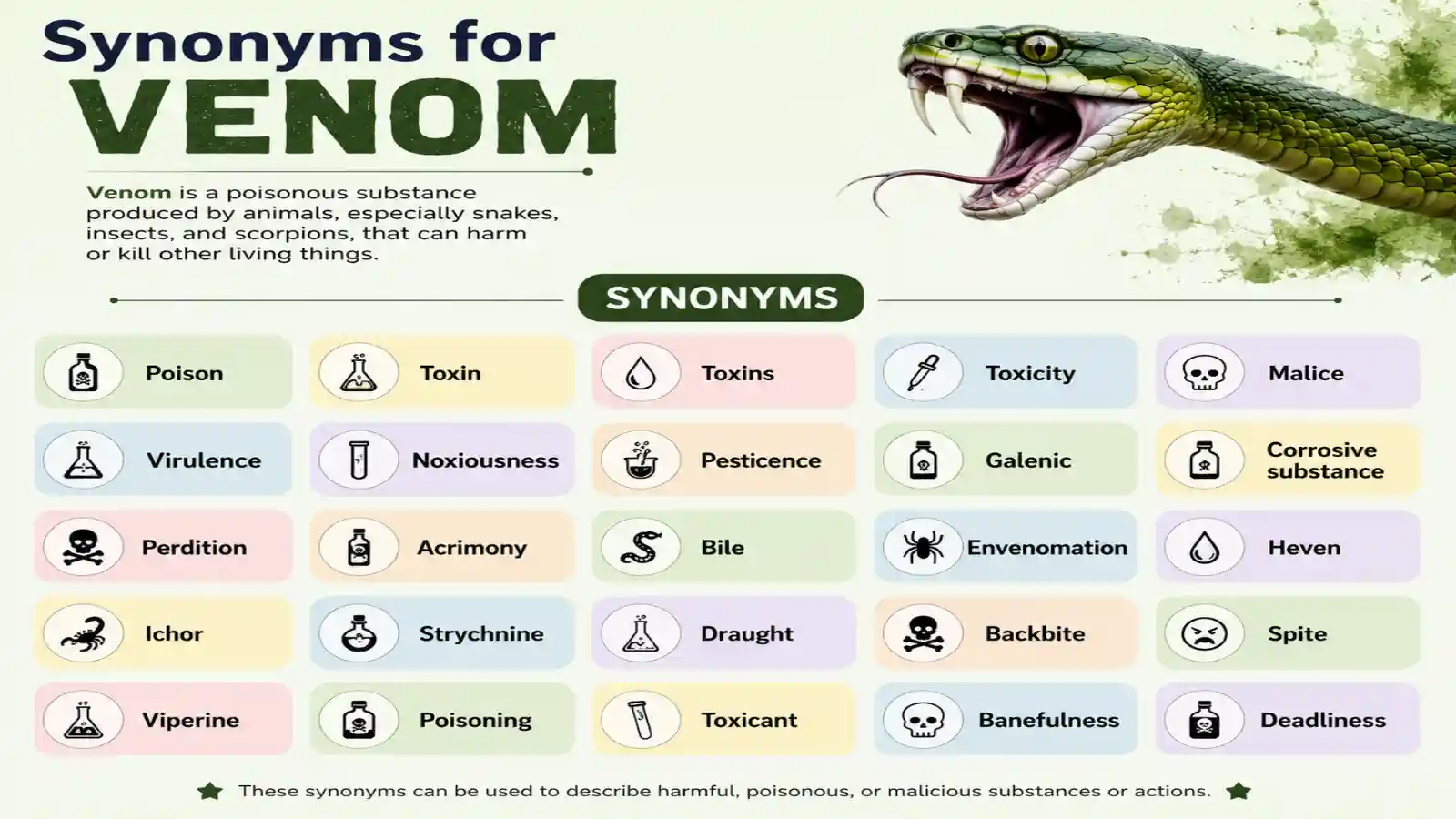
Have you ever seen a snake and wondered what makes its bite so dangerous? The answer is often venom, a harmful substance that some animals inject into another animal through a bite or sting.
For example, a cobra can inject venom when it bites a person. The word venom can also describe very strong hatred or anger in writing. For example, “He spoke with venom” means he spoke with great bitterness.
Learning synonyms for venom helps you choose the right word for different situations. Students can use these words in essays and exams. Bloggers and content writers can avoid repeating the same word. Daily English users can speak and write with more variety.
This guide explains 30 synonyms for venom in simple English, with clear examples.
Quick Answer
Some common synonyms for venom include poison, toxin, poison, bitterness, malice, spite, hostility, and rancor. However, the best synonym depends on whether you mean a harmful substance from an animal or a feeling of deep anger and hatred.
Parts of Speech
| Word | Part of Speech | Simple Meaning |
| Venom | Noun | A harmful substance injected by some animals |
| Poison | Noun | A substance that can harm or kill |
| Toxin | Noun | A poisonous substance made by a living thing |
| Antidote | Noun | A substance used to fight a poison |
| Bitterness | Noun | Strong angry or hateful feeling |
| Malice | Noun | A wish to hurt someone |
| Spite | Noun | A desire to hurt or upset someone |
| Hostility | Noun | Unfriendly or angry behavior |
| Hatred | Noun | A very strong feeling of dislike |
| Rancor | Noun | Long-lasting anger or hatred |
Main Content – Synonyms for Venom
1. Poison
Meaning: Poison is a harmful substance that can make a person or animal sick or cause death.
Examples:
- The snake’s bite left poison in the victim’s body.
- The police found poison in the bottle.
2. Toxin
Meaning: A toxin is a harmful substance made by a living thing.
Examples:
- The spider produces a powerful toxin.
- Scientists tested the toxin in the laboratory.
3. Toxic Substance
Meaning: A toxic substance is something that can harm the body.
Examples:
- The workers wore gloves near the toxic substance.
- The label warned people about the toxic substance.
4. Poisonous Substance
Meaning: A poisonous substance can cause serious harm if it enters the body.
Examples:
- The snake carries a poisonous substance.
- Keep this poisonous substance away from children.
5. Toxicity
Meaning: Toxicity is the level at which something can harm a living body.
Examples:
- The doctor explained the toxicity of the chemical.
- The researchers measured its toxicity carefully.
6. Venomous Secretion
Meaning: A venomous secretion is a harmful liquid produced by some animals.
Examples:
- The insect released a venomous secretion.
- Scientists studied the venomous secretion of the spider.
7. Bane
Meaning: A bane is something that causes great harm or trouble.
Examples:
- Fear became the bane of his confidence.
- Pollution is a bane for many cities.
8. Harm
Meaning: Harm means physical or emotional damage.
Examples:
- The snake can cause serious harm.
- His angry words caused emotional harm.
9. Danger
Meaning: Danger is the chance that something bad or harmful may happen.
Examples:
- The sign warned us about the danger.
- The venomous snake was a serious danger.
10. Threat
Meaning: A threat is something that may cause harm.
Examples:
- The snake was a threat to the hikers.
- His angry message sounded like a threat.
11. Bitterness
Meaning: Bitterness is a strong feeling of anger or sadness toward someone.
Examples:
- She spoke with bitterness about the unfair decision.
- Years of bitterness damaged their friendship.
12. Malice
Meaning: Malice is a strong wish to hurt another person.
Examples:
- He made the comment with malice.
- She did not act with malice.
13. Spite
Meaning: Spite is a desire to hurt or upset someone because you are angry.
Examples:
- He ignored her out of spite.
- She posted the message out of spite.
14. Hostility
Meaning: Hostility is angry or unfriendly behavior toward someone.
Examples:
- The two groups showed open hostility.
- His hostility made the meeting uncomfortable.
15. Hatred
Meaning: Hatred is a very strong feeling of dislike toward someone or something.
Examples:
- Hatred can destroy close relationships.
- His words were filled with hatred.
16. Rancor
Meaning: Rancor is deep anger that lasts for a long time.
Examples:
- They ended the argument without rancor.
- Years of rancor kept the families apart.
17. Animosity
Meaning: Animosity is a strong feeling of dislike or anger toward someone.
Examples:
- There was clear animosity between the two teams.
- They worked together despite their animosity.
18. Enmity
Meaning: Enmity is a strong feeling of hatred between people or groups.
Examples:
- Their old enmity affected the whole community.
- The leaders tried to end their enmity.
19. Acrimony
Meaning: Acrimony is angry and bitter speech during a disagreement.
Examples:
- The debate ended in acrimony.
- Their conversation was full of acrimony.
20. Hostile Feeling
Meaning: A hostile feeling is an angry or unfriendly emotion toward someone.
Examples:
- He had a hostile feeling toward his former partner.
- She tried to hide her hostile feelings.
21. Ill Will
Meaning: Ill will is an unfriendly feeling toward another person.
Examples:
- I have no ill will toward my former classmate.
- Their disagreement created ill will.
22. Contempt
Meaning: Contempt is a strong feeling that someone is unworthy of respect.
Examples:
- He looked at the dishonest man with contempt.
- Her voice showed clear contempt.
23. Fury
Meaning: Fury is extremely strong anger.
Examples:
- His face showed fury after the insult.
- She could barely control her fury.
24. Wrath
Meaning: Wrath is very strong anger, often shown in serious or formal writing.
Examples:
- The king feared the wrath of his people.
- His decision brought the wrath of the crowd.
25. Rage
Meaning: Rage is very strong and uncontrolled anger.
Examples:
- He shouted in rage.
- The unfair result filled her with rage.
26. Resentment
Meaning: Resentment is angry feelings caused by unfair treatment.
Examples:
- She felt resentment after being ignored.
- His resentment grew over the years.
27. Viciousness
Meaning: Viciousness is cruel behavior that is meant to hurt someone.
Examples:
- The viciousness of the attack shocked everyone.
- His words showed unusual viciousness.
28. Cruelty
Meaning: Cruelty is behavior that causes pain or suffering on purpose.
Examples:
- The animal suffered because of human cruelty.
- Everyone condemned his cruelty.
29. Malevolence
Meaning: Malevolence is a strong wish to cause harm.
Examples:
- His actions revealed clear malevolence.
- The story describes the villain’s malevolence.
30. Vindictiveness
Meaning: Vindictiveness is a strong desire to punish someone because of anger.
Examples:
- His vindictiveness damaged his reputation.
- She refused to respond with vindictiveness.
How to Choose the Right Synonym for Venom
Not every synonym for venom can replace the word in every sentence.
When talking about a snake, spider, scorpion, or other animal, poison, toxin, and toxic substance may work depending on the context. However, there is an important distinction between venom and poison.
Venom is normally delivered through a bite, sting, or similar mechanism. Poison generally causes harm when it is swallowed, inhaled, absorbed, or otherwise taken into the body.
When venom is used in a figurative sense, words such as bitterness, malice, spite, hatred, rancor, and animosity are often more suitable.
For example:
- Literal: The snake injected venom into its victim.
- Figurative: He spoke with venom about his former employer.
This distinction is useful for students, writers, and anyone who wants to use English precisely.
Frequently Asked Questions
1. What is the best synonym for venom?
Poison is a common synonym when talking about a harmful substance, but toxin may be more precise when referring to a poisonous substance produced by a living organism.
2. What is a synonym for venom in an angry context?
Words such as bitterness, malice, spite, hatred, rancor, and animosity can describe venom when the word refers to angry or hateful speech.
3. Is poison the same as venom?
No. Venom is usually injected by an animal through a bite or sting, while poison can harm a person when it is swallowed, inhaled, absorbed, or otherwise enters the body.
4. What is the opposite of venom?
There is no single perfect opposite in every context. For the literal meaning, medicine or antidote may provide a useful contrast. For the figurative meaning, kindness, goodwill, or love can be opposites.
5. Can venom describe a person’s words?
Yes. Venom can be used figuratively to describe words or speech that are extremely bitter, hateful, or malicious.
6. What is the difference between venom and toxin?
A toxin is a poisonous substance produced by a living organism. Venom is a type of toxic secretion that is actively delivered into another organism, often through a bite or sting.
7. What are common synonyms for venom in writing?
Common choices include poison, toxin, bitterness, malice, spite, hostility, hatred, rancor, animosity, and enmity. The correct choice depends on the sentence and intended meaning.
Conclusion
Learning synonyms improves your writing, blogging, speaking, and everyday communication. Instead of using the word “venom” again and again, you can choose a word that fits your exact meaning. Practice these synonyms in emails, essays, blog posts, and daily conversations. Start with simple words such as poison, toxin, bitterness, and spite, then slowly add stronger words such as rancor, acrimony, and malevolence. The more you practice, the more natural your English vocabulary will become.

Habib Ullah is the founder of LanguagePilots, where he creates easy-to-understand English learning content to help students and professionals build confidence in communication.